

Kettle Chips: History, Flavors & Varieties
Please leave a review or any memories of this snack in the comments at the end of this post.
Snack History Nostalgia Rating: ⭐⭐⭐☆☆
How did Kettle Chips accomplish capturing the hearts and minds of so many people in different countries? How did the brand create such a delectable crunch, and what is the secret to its success? We need to take a journey back in time to late 1970s America to uncover the answers since that is when crisp, salty, crunchy, and delectable snacks were still a novelty in society.
So let’s explore the deliciously intriguing depths of the genuinely flavorful Kettle Chips and find out why they will quickly become your new favorite snack.
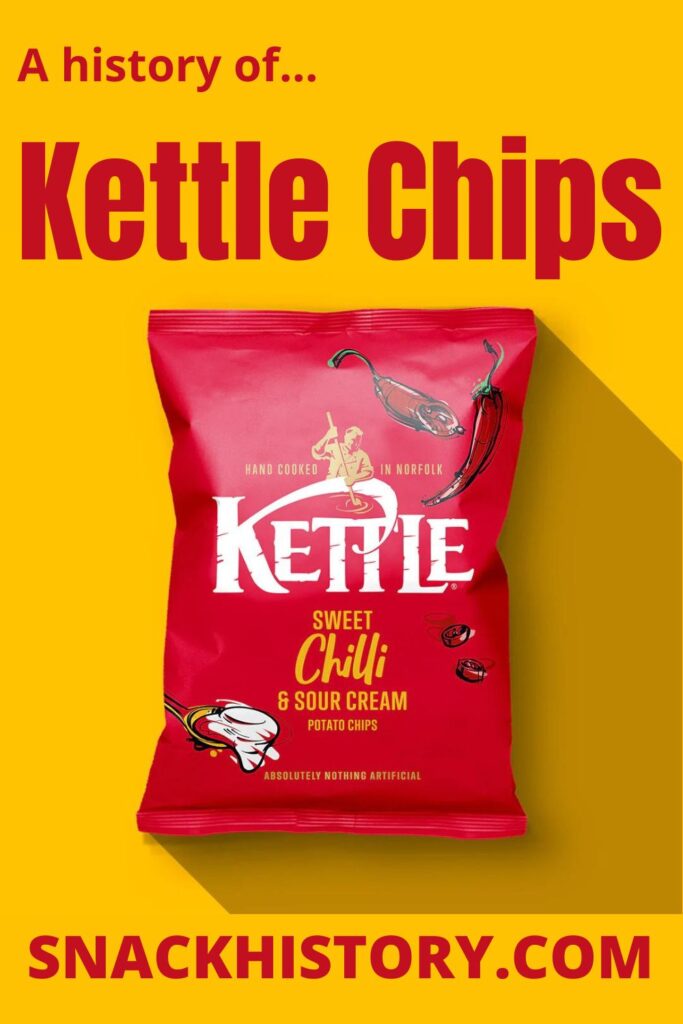
| Kettle Chips | Facts |
|---|---|
| Introduced | 1982 |
| Manufacturer | Kettle Foods |
| Chip Type | Batch-cooked kettle potato chips |
| Original Flavors | Red Chili and Yogurt, Green Onion |
| Still Available | Yes |
| Country of Origin | United States |
| UK Manufacturing Location | Norfolk, England |
| Cooking Oil Used | Safflower oil |
History
Cameron Healy founded his company in 1978, intending to provide high-quality, naturally derived products. Cameron headed on the road with nothing more than a vintage vehicle and an entrepreneurial spirit, selling cheese and roasted nuts to organic grocery stores. Kettle Foods was performing successfully, but Cameron’s first taste of one of the Hawaiian snacks, homemade potato chips, altered everything. Therefore, when he returned home, he started experimenting with traditional chip manufacturing processes.
As a result, in 1982, he shifted gears and set his sights on creating the best potato-style chip imaginable. It took some time to perfect the process. However, Kettle Chips were developed soon after. Six years later, Healy traveled to the United Kingdom with his son and found the British love of potato chips, which they refer to as “crisps.” Therefore, he moved his business to the United Kingdom and established one of the most beloved British snacks.
The kettle still manufactures its chips in Norfolk, and the majority of the potatoes are cultivated within 30 miles of Norwich.
Kettle Chips Timeline
- 1978 — Cameron Healy founds Kettle Foods, selling cheese and roasted nuts.
- 1982 — Kettle Chips officially launched after Hawaiian chip inspiration.
- 1988 — Healy travels to UK, discovers British passion for crisps.
- 1988 — Kettle Foods expands to the United Kingdom market.
- Ongoing — Production established in Norfolk, potatoes sourced near Norwich.
Kettle Chips vs Cape Cod Potato Chips
| Feature | Kettle Chips | Cape Cod Potato Chips |
|---|---|---|
| Texture | Thick, sturdy, irregular shape with caramelized flavor | Thick, crunchy, kettle-cooked style |
| Introduced | 1982 | 1980 |
| Manufacturer | Kettle Foods | Snyder's-Lance |
| Cooking Method | Batch cooking in oil-filled kettle | Kettle-cooked batch process |
| Flavor Variety | Approximately 15 flavors including Sea Salt & Vinegar and Jalapeño | Multiple flavors including Sea Salt and Aged Cheddar |
| Availability | US and UK (Norfolk-based UK production) | Primarily United States |
| Non-GMO / Natural Positioning | Yes, zero-waste and all-natural brand commitment | Yes, uses simple natural ingredients |
How Kettle Chips Are Made
Some individuals believe that kettle chips are healthier than non-kettle-cooked chips since they taste more potato-like and thus more natural. The primary distinction between a kettle chip and a standard potato chip is how they are prepared. Regular potato chips like Terra Chips and Gibble’s Chips are produced using a method known as continuous frying.
Kettle chips are made using an older technique known as batch cooking, in which cold potatoes are tossed into an oil-filled kettle. The process is repeated by adding and stirring another batch of potatoes. The temperature of the oil drops with each successive batch of cold potatoes that enters the vat. The cooler oil slows the cooking time, resulting in more vibrant chips with strange, irregular shapes. Even though the components essential for manufacturing both types of chips are comparable, the resulting potato chips appear and taste different.
The batching approach takes slightly longer to prepare the potatoes, however, this allows the starch in the potatoes to soak up moisture and dissolve before the potatoes accomplish preparation. As a result, the chip becomes thicker and sturdier, with a caramelized flavor. Given that the oil remains exceptionally hot in the continuous-processing method, moisture in the potato drains rapidly, leaving the chip light, crispy, and finely textured.
Wide Variety of Flavors
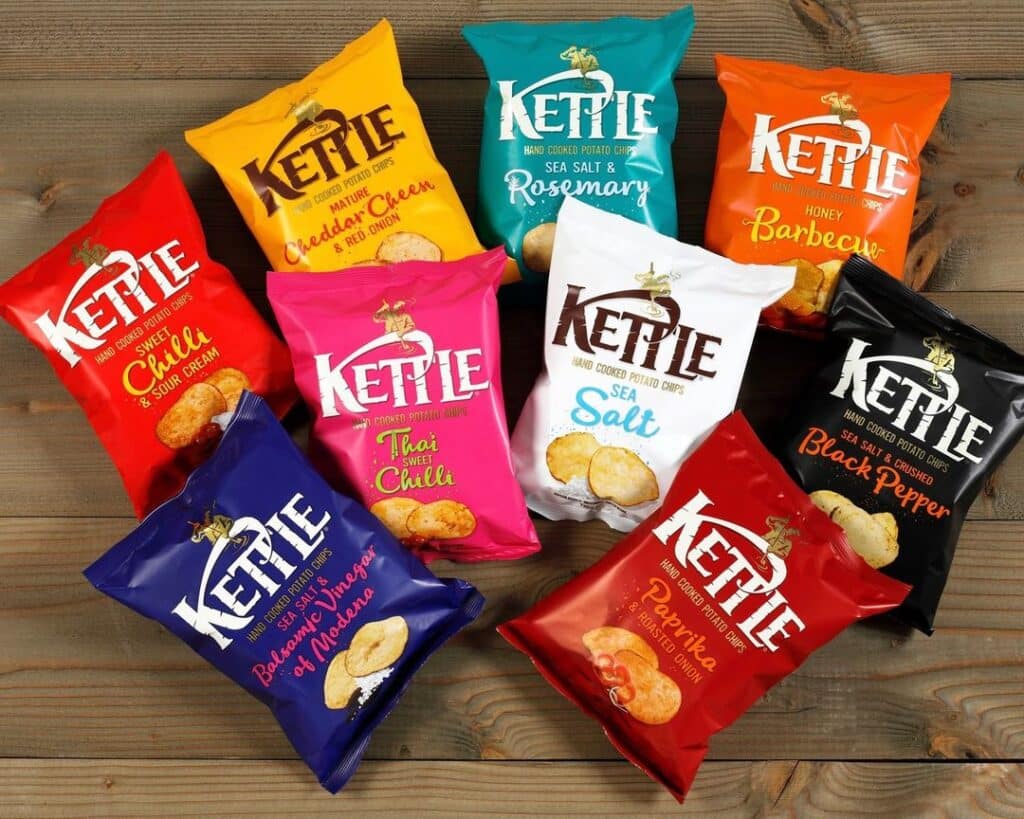
Can’t pick which flavor chip to devour? It’s pretty hard when Kettle Brand has roughly 15 flavors, ranging from Farmstand Ranch to Backyard Barbeque to Pepperoncini. Which bags are individuals most likely to take from the shelves? The most popular flavors are Sea Salt Vinegar and Jalapeno!
Since its inception, Kettle Brand has specialized in producing chips with distinctive flavors, like its initial varieties which included Red chili and yogurt and Green Onion.
When it comes to flavors, the company is still very concerned about innovation. The Kettle brand employs in-house chefs who experiment with novel flavors. As a result, you may notice a different flavor at your local supermarket multiple times per year. This ongoing innovation and dedication to hand-crafted cooking is what makes the product such a welcome addition to many households’ snack cupboards.
Quick Quiz
Which Of These Is The Oldest Candy?
You might be wondering if Kettle chips flavors are vegan. Therefore you should know that while not all Kettle Chip flavors are vegan, a large selection is! Vegan variations include:
- Backyard Barbecue
- Jalapeno
- Maple Bacon
- Pepperoncini
- Red Curry
- Roasted Garlic
- Sea Salt
- Sea Salt & Vinegar
- Sea Salt & Cracked Pepper
- Spicy Thai
- Sriracha
- Unsalted.
How Do Kettle Chips Differentiate Themselves? Green Technology & Emissions Reduction
The majority of Kettle Brand’s operational decisions reflect the company’s dedication to becoming an all-natural, non-GMO, zero-waste brand. The production site in Salem, Oregon, is close to a two-acre wetland with hiking trails, floral diversity, and wildlife. Personnel are encouraged to spend their lunch breaks outside, where they can enjoy the natural world.
Kettle Chips relies on a distinctive kind of potato identified as the Russet Burbank potato, which is frequently referred to as a “high sugar potato.” Safflower oil, chosen for its mild flavor, is used to cook Russet Burbank potatoes. In keeping with the zero-waste philosophy, the oil is reused for company vehicles as an alternate fuel source.
Since 2006, the corporation has purchased wind energy credits. Furthermore, approximately 600 solar panels function on the rooftops to create extra power while lowering CO2 emissions.
Sustainable Packaging
Plastic is still causing worry on a global scale due to its pervasiveness in the market and the impact it has on the environment, so brands are taking action, and Kettle Chips is no exception.
At the Natural Products Expo West, the company debuted new packaging with a three-film design rather than its regular five-layer packaging. This lowers the quantity of plastic used by 43% while additionally supporting the brand in reducing its greenhouse gas emissions by 51% per year.
While Kettle Chips is still looking for entirely recyclable or biodegradable options that safeguard product quality and work within recycling systems, its immediate focus is on decreasing the overall impact. This current generation of kettle chip packaging marks a significant advancement while also making it exceptionally simple to open the bags, which is something fans frequently request.
Logo
Kettle Chips Around the World
The enduring appeal of Kettle Chips extends far beyond the Pacific Northwest. Commonly known as the Kettle Brand, Kettle Chips are one of the most prominent American snacks. Kettle has reached a large network of consumers all over the world with slightly distinctive flavors and similar vivid and colorful packaging.
In America, Kettle is operated by Campbell’s, which also owns Cape Cod Potato Chips. Since 2019, the consumer products conglomerate Valeo Foods Group has owned the brand in Europe and the United Kingdom. The kettle is the third largest shared snack brand in the UK. Annually, it has a 9% market share, with 250,000 packages sold daily and even far more transported to 23 countries.
People just adore potato chips, as seen by their purchasing and consumption habits in the United Kingdom and Europe. In 2018, snacks such as chips accounted for 17 billion euros in sales, with the Netherlands and Spain accounting for the vast majority of this consumption, with each person eating more than 4 kilograms on average. Imagine consuming 8 pounds of chips every year, but with the crunch of a kettle-cooked chip, it’s easy to understand how you would exceed that limit.
Ingredients
Kettle chips are produced with genuine ingredients for their exceptional taste and texture, with no added artificial flavors or Monosodium glutamate (MSG), which is considered unhealthy. People who are truly passionate about what they accomplish produce everything with devotion. They seek the best potatoes, farmed locally whenever possible, and then manually cook them in small batches with diligence, seasoning them with simply delicious combinations of spices.
While Kettle Chips with Sea Salt comprise only three ingredients: organic potatoes, pure vegetable oil (safflower and/or sunflower oil), and sea salt, the numerous distinct flavors employ natural flavors, spices, citric acid, and yeast extract.
For instance, the components for sea salt & vinegar kettle chips consist of:
- Potatoes
- Safflower and or/Sunflower and/or Canola Oil
- Vinegar Powder (Maltodextrin, White Distilled Vinegar)
- Sea Salt,
- Maltodextrin
- Citric Acid.
Nutritional Value
A food’s nutritional value, also known as nutritive value, refers to how well-balanced the important nutrients (carbs, fat, protein, minerals, and vitamins) are concerning the nutrient needs of the consumer. To rank food according to its nutritional worth, several nutritional rating systems and nutrition data labels have been put in place.
Even though chips are not generally regarded as healthy foods, Kettle Chips only feature products with zero added sugar and fewer than 250 mg of salt per serving, so they can be viewed as being on the healthier end of the spectrum.
Organic kettle chips feature superior ingredients, taste better, and contain fewer free radicals. Per serving, there are 150 calories, 9 grams of total fat, 17 grams of carbohydrates, and 2 grams of protein. As for useful substances, it should be noted that Kettle Chips contain 15% vitamin C and 2% iron.
| Serving Size: | 1 oz (28g) | % Daily Value* |
| Amount Per Serving | ||
| Calories | 149 | |
| Total Fat | 9.5g | 12% |
| Saturated Fat | 1g | 5% |
| Trans Fat | 0g | |
| Polyunsaturated Fat | 2.3g | |
| Monounsaturated Fat | 5.3g | |
| Cholesterol | 0mg | 0% |
| Sodium | 148mg | 6% |
| Total Carbohydrates | 15g | 5% |
| Dietary Fiber | 0.9g | 3% |
| Sugars | 0.1g | |
| Protein | 1.8g | |
| Vitamin D | 0mcg | 0% |
| Calcium | 5.9mg | 0% |
| Iron | 0.4mg | 2% |
| Potassium | 334.9mg | 7% |
| Caffeine | 0mg |
- The % Daily Value (DV) tells you how much a nutrient in a serving of food contributes to a daily diet. 2000 calories a day is used for general nutrition advice.
Pictures
Bottom Line
As you can see, these thick-cut, whole-potato Kettle Chips have a history as old as their flavor selection and are created using authentic flavor recipes. It’s common to see kettle chips at celebrations, get-togethers, and as a side dish with the main course. They’re a mainstay of popular culture, and even though they are popular all over the world, several countries still create their own unique chip flavors to suit their preferences.
FAQ
How are Kettle Chips made?
Kettle chips are fried in batches, dipped, and swirled around in hot oil for longer periods of time until they’re crunchier and caramelized to a deeper color.
What are Kettle Chips?
Kettle Chips are a type of potato chip made so as to be thicker and crunchier than the typical potato chip.
Who owns Kettle Chips?
u003cstrongu003eKettle Foods, Inc.u003c/strongu003e is an American manufacturer ofpotato chips, based in Salem, Oregon, United States, with a European and Middle East headquarters in Norwich, United Kingdom.
Frequently Asked Questions about Kettle Chips
Who founded Kettle Chips and when did the brand start?
Cameron Healy founded Kettle Foods in 1978, originally selling cheese and roasted nuts to organic grocery stores from a vintage vehicle. After tasting homemade potato chips in Hawaii, he shifted focus and launched Kettle Chips in 1982 after experimenting with traditional chip manufacturing processes.
What makes Kettle Chips different from regular potato chips?
Kettle Chips are made using an older batch-cooking method, where cold potatoes are added to an oil-filled kettle in successive batches, lowering the oil temperature and slowing the cooking process. This allows the starch to absorb moisture and dissolve before cooking completes, resulting in a thicker, sturdier chip with a caramelized flavor and irregular shape, unlike the light, finely textured chips produced by continuous frying.
What are the most popular Kettle Chips flavors?
According to Kettle Brand, the most popular flavors are Sea Salt & Vinegar and Jalapeño. The brand offers approximately 15 flavors in total, ranging from Farmstand Ranch and Backyard Barbeque to Pepperoncini, and regularly introduces new varieties developed by in-house chefs.
Are Kettle Chips vegan?
Not all Kettle Chips flavors are vegan, but a large selection is. Vegan-friendly flavors include Backyard Barbecue, Jalapeño, Pepperoncini, Red Curry, Roasted Garlic, Sea Salt, Sea Salt & Vinegar, Sea Salt & Cracked Pepper, Spicy Thai, Sriracha, and Unsalted. Notably, the Maple Bacon flavor is also listed among the vegan options.
Where are Kettle Chips made in the United Kingdom?
Kettle Chips are manufactured in Norfolk, England, and the majority of the potatoes used are grown within 30 miles of Norwich. Cameron Healy expanded to the UK after traveling there with his son and discovering the British passion for potato chips, which they call crisps.


Related Posts
Milky Way Candy: History, Ingredients & Varieties
Please leave a review or any memories of this snack in the comments at the end of this post. Snack History Nostalgia Rating: ⭐⭐⭐⭐⭐…
Read more
Chips Ahoy!: History, Varieties & Availability
Please leave a review or any memories of this snack in the comments at the end of this post. Chips Ahoy! is an American…
Read more
Ocean Spray: History, Facts & Trivia
Please leave a review or any memories of this snack in the comments at the end of this post. Snack History Nostalgia Rating: ⭐⭐⭐⭐☆…
Read more