

Swedish Fish: History, Ingredients & Nutrition

Quick answer: Swedish Fish were developed in 1957 by the Swedish candy maker Malaco for the US market. The chewy fish-shaped candies are still sold today, made by Mondelez International under the Maynard brand in North America.
Some people aren’t big fans but many of us remember growing up with Swedish Fish and still turn to these fun chewy candies to enjoy when we want that little something sweet. Swedish Fish have been around forever, it seems.
One of the interesting things about this unique candy is that they are labeled as fat-free and gluten-free. Is it really so that a yummy gummy candy could really have those qualities? Let’s take a look at the history and details of the popular Swedish candy.
| Swedish Fish | Facts |
|---|---|
| Introduced | 1957 (originally created for the U.S. market) |
| Manufacturer | Malaco (Sweden); Mondelez International / Maynard brand (North America) |
| Candy Type | Gummy / chewy fish-shaped candy |
| Original Flavor | Red (exact flavor unverified) |
| Still Available | Yes, widely available online and in candy shops |
| Country of Origin | Sweden |
| Parent Company | Mondelez International (North America & Turkey); Malaco (Sweden) |
| Current Production (North America) | Hamilton, Ontario, Canada |
History
Swedish Fish would now be considered an old-fashioned candy. It’s been around for so long and continues to be a popular choice in some areas. It’s one you can always order online but if you walk into any old-time candy shop or a location that often has some of these older candies, you’re bound to find the fish and be able to reminisce and savor.
Swedish Fish were originally introduced in the U.S. in 1957, when Swedish candy maker Malaco developed them for the American market. When you pick up a bag or package of Swedish Fish, you may notice right away that there is a label that says “A fat-free food” right above the candy name.
This sweet treat is also gluten-free. While the most common Swedish Fish is red, there are other colors too. There are not a ton of colors. Most packages have red, green, and yellow fish. There is also a black fish in Sweden that is flavored with salmiak, a salty licorice.
Swedish Fish are gummy candy that is sweet and shaped like a fish. It even has a lot of detailing on the gummy for the fins, scales, and head of the fish. It’s pretty unique compared to other gummy candies on the market.
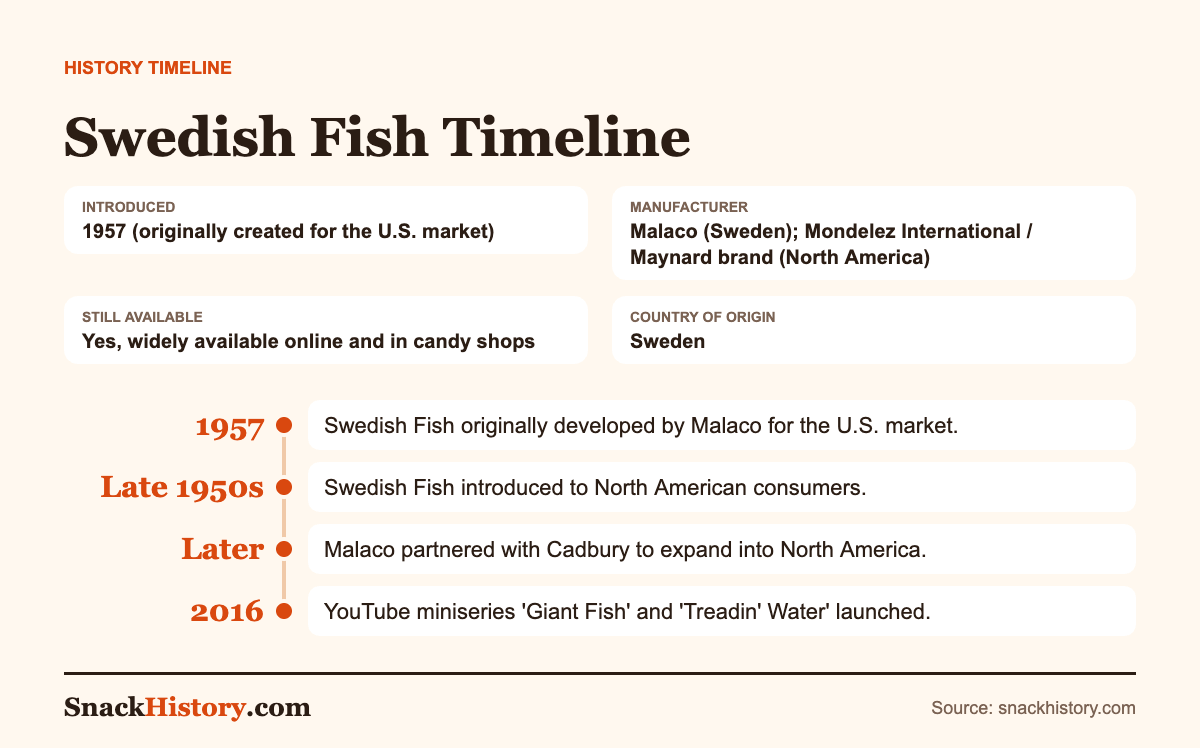
Swedish Fish Timeline
- 1957 — Swedish Fish originally developed by Malaco for the U.S. market.
- Late 1950s — Swedish Fish introduced to North American consumers.
- Later — Malaco partnered with Cadbury to expand into North America.
- 2016 — YouTube miniseries 'Giant Fish' and 'Treadin' Water' launched.
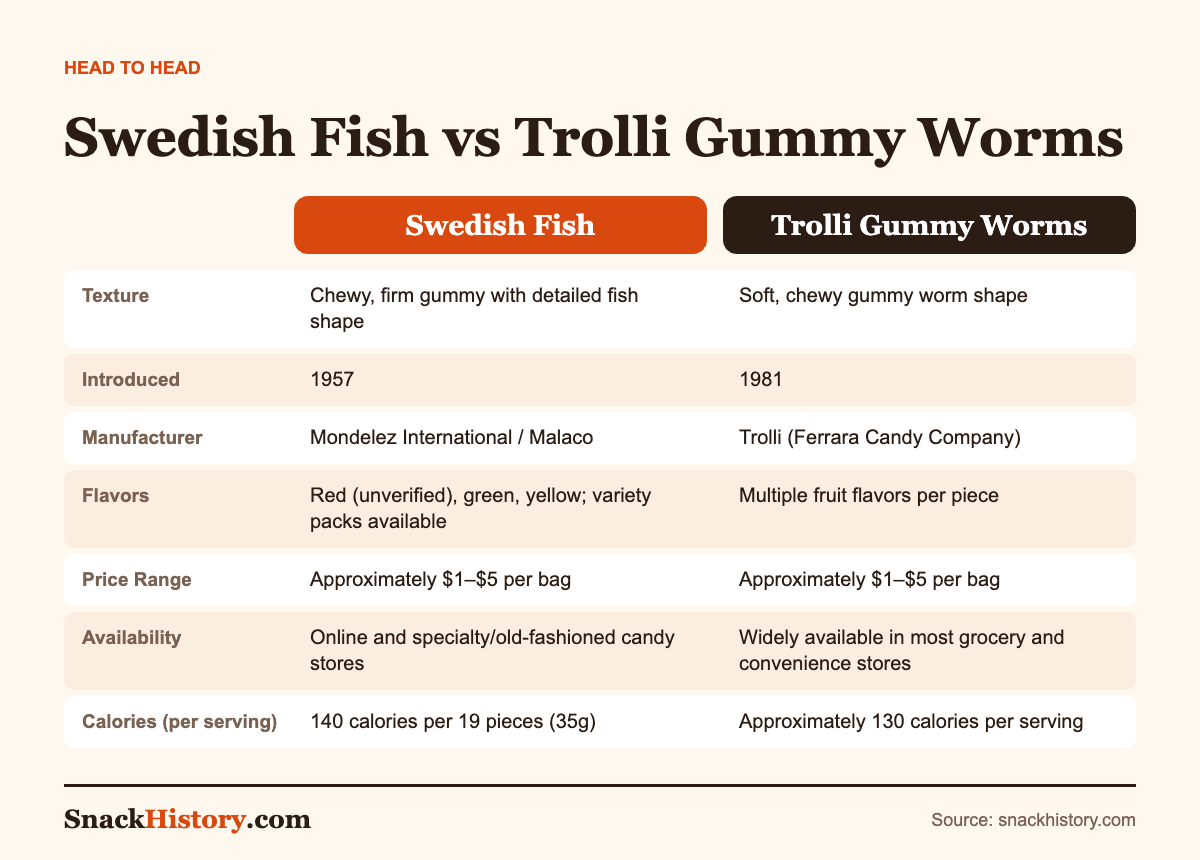
Swedish Fish vs Trolli Gummy Worms
| Feature | Swedish Fish | Trolli Gummy Worms |
|---|---|---|
| Texture | Chewy, firm gummy with detailed fish shape | Soft, chewy gummy worm shape |
| Introduced | 1957 | 1981 |
| Manufacturer | Mondelez International / Malaco | Trolli (Ferrara Candy Company) |
| Flavors | Red (unverified), green, yellow; variety packs available | Multiple fruit flavors per piece |
| Price Range | Approximately $1–$5 per bag | Approximately $1–$5 per bag |
| Availability | Online and specialty/old-fashioned candy stores | Widely available in most grocery and convenience stores |
| Calories (per serving) | 140 calories per 19 pieces (35g) | Approximately 130 calories per serving |
Ingredients
Considering the packaging of Swedish fish and the claim to no fat, their ingredients are interesting and might be something that turns people away. Here are the ingredients in the candy.
- Sugar
- Invert sugar
- Corn syrup
- Modified corn starch
- Citric acid
- Natural and artificial flavors
- White mineral oil
- Carnauba wax or beeswax
- Red, yellow, and blue dye
The ingredients serve a purpose but are unusual considering the labeling. Invert sugar is used in this case because the fish could retain moisture so it helps with that. The fructose used in the ingredients allows Swedish fish to have an incredibly long shelf life. They are not likely to spoil any time soon.
The modified cornstarch is what is used to shape the fish and get them to hold their shape. These fish are molded into trays as part of the creation process. White mineral oil is supplemented to the modified cornstarch as well so that the fish come out shiny and don’t crumble.
We touched on the ingredients mostly because some of these may cause some to raise their eyebrows. It’s interesting to see the purpose behind the choice of ingredients and to know these are still popular.
Nutrition
| Serving Size: | 19 pieces (35g) | % Daily Value* |
| Amount Per Serving | ||
| Calories from Fat | 0 | |
| Calories | 140 | |
| Total Fat | 0g | 0% |
| Saturated Fat | 0g | 0% |
| Cholesterol | 0mg | 0% |
| Sodium | 16mg | 1% |
| Potassium | 1.8mg | 0% |
| Total Carbohydrates | 35g | 12% |
| Dietary Fiber | 0g | 0% |
| Sugars | 21g | |
| Protein | 0g | |
| Vitamin A | 0% | |
| Vitamin C | 0% | |
| Calcium | 0% | |
| Iron | 1% |
- Percent Daily Values are based on a 2000 calorie diet.
Where is Swedish Fish Manufactured
In the current day, Swedish Fish in the North American continent are manufactured in Canada. They are made in Hamilton, Ontario. In Canada, the y are distributed under Mondelez International’s Maynards Bassetts brand.
These fish are made in a couple of other countries as well. In Turkey, they are still known as Swedish Fish but made by Mondelez International. In Sweden, the fish are known are pastellfiskar and made by the Malaco brand. There are some other brands that make a similar product in that area as well. However, the Malaco brand is a well-known option and they have a mixed candy bag that contains fish in it.
Interestingly, the company created YouTube channels in 2016 because of the renewed popularity of Swedish Fish. These created advertisements are known as “Giant Fish” and “Treadin’ Water” as a miniseries.
The original Swedish Fish were all red but we mentioned earlier there are other colors now. The red color was the original, as was the flavor – which has never really been verified. We will talk more about the flavors shortly.
When Was Swedish Fish Invented?
Swedish Fish were developed by Malaco in 1957, although the individual who invented them isn’t known. However, we do know that they were developed in Sweden for the American market.
Fish was used because it is one of the main parts of the Swedish diet. Fishing is also a popular pastime in Sweden culture.
Malaco (the Swedish Fish Company) later partnered with Cadbury to expand the candy’s reach in North America. Malaco is still very much in control in Sweden and continues to produce and distribute the candy there.
In North America, the production and distribution take place through Mondelez now, rather than Cadbury as was the original party in North America. Mondelez is headquartered in Chicago, but makes North American Swedish Fish in Hamilton, Ontario, Canada.
Who Invented the Swedish Fish?
We don’t really know the history of a specific individual who came up with some great ideas to create Swedish Fish. Most of the history is related to the Swedish company that developed the candy for American buyers.
This company was Malaco and Malaco still produces Swedish Fish in Sweden today. Swedish Fish were actually developed specifically for the North American market, where they launched in 1957.
Malaco did a great job of displaying Swedish culture with a fish that looks almost realistic. They chose fish because it’s a common part of the Swedish diet but also because fishing is a popular hobby in Sweden as well.
When Malaco partnered with a North American company, originally they used Cadbury. However, since that time, Mondelez is now the company that makes and distributes them throughout North America, producing them in Canada.
There have been some other partnerships as well in more recent years. In 2009, Rita’s Italian Ice had a flavor known as Swedish Fish flavored ice that was co-branded with Swedish Fish. The Trident company produced a berry + lemon flavor that was meant to imitate Swedish Fish as well. Trident is also owned by Mondelez.
Nabisco also has a Swedish Fish flavored Oreo for a while in 2016. They were only available at Kroger stores throughout the U.S. but are no longer in production.
Logo

Buying Online
Just like in the store, you can easily find online as well. It’s available through many grocery retailers and it’s also available through online candy stores. You will find it on Amazon as well.
The bottom line is that if you’re looking for Swedish Fish, you probably won’t really have any troubles finding it to soothe that sweet tooth.
Flavors
The original was only available in red. There was also a time where the small sizes of the fish were only in red but you could buy larger Swedish Fish in all of the colors. The colors remain very limited with 3 basic colors. They have had some other colors over the years but red, green, and yellow remain the primary colors you will find.
There has always been a lot of controversy over the actual flavor of the redfish, though. A lot of people assume it is cherry and stick to their guns on that fact. We think that since it’s a red candy people simply assume it’s cherry.
There is also a common rumor that the flavor is actually lingonberry. This berry is also known as cowberries. The berry is bright red and is found and used more in Nordic or Baltic cultures so it could make sense for Swedish fish. However, no flavor has ever been officially confirmed by the companies.
They did have a grape flavor for a while but this was discontinued as of 2006. They also have had orange, lemon-lime, and pineapple in their flavors.
Did you know that in the detail of the fish, the word Swedish is also branded in there from the mold?
Also – in Sweden, they have a black Swedish Fish, which is flavored with salmiak, a salty licorice. Certainly not the same flavor ad you might expect when you eat a piece of candy but they seem to like it there and it ties in with the cultural aspect of the candy as well.
Pictures


Advertising
Where to Buy?
Swedish Fish are pretty easy to find. You can locate them at just about any traditional candy shop. The Old Time Candy stores always have them. They are also pretty commonly found at grocery stores and gas stations too.
While this candy may not be everyone’s favorite, it remains a popular choice and it is pretty easy to find at just about any store that sells candy.
FAQ
What flavor are Swedish Fish?
There has always been a lot of controversy over the actual flavor of the redfish, though. A lot of people assume it is cherry and stick to their guns on that fact. We think that since it’s a red candy people simply assume it’s cherry. u003cbru003eThere is also a common rumor that the flavor is actually lingonberry. This berry is also known as cowberries. The berry is bright red and is found and used more in Nordic or Baltic cultures so it could make sense for Swedish fish. However, no flavor has ever been officially confirmed by the companies.
Why are Swedish Fish called Swedish Fish?
Fish was used because it is one of the main parts of the Swedish diet. Fishing is also a popular pastime in Sweden culture. The candy was known in the U.S. already but was popular in Sweden.
Frequently Asked Questions about Swedish Fish
What flavor are Swedish Fish?
The exact flavor of the original red Swedish Fish has never officially been verified. While many people associate the taste with a general fruit or berry flavor, the manufacturers have not confirmed a specific flavor. This mystery has only added to the candy's intrigue over the decades.
Are Swedish Fish gluten-free and fat-free?
Yes, Swedish Fish are labeled as both fat-free and gluten-free. The packaging prominently features the claim 'A fat-free food' right above the candy name. This makes them a popular choice for those avoiding gluten or fat in their diet, though they are still high in sugar and carbohydrates.
Where are Swedish Fish made today?
In North America, Swedish Fish are currently manufactured in Hamilton, Ontario, Canada under Mondelez International's Maynard brand. They are also produced in Turkey by Mondelez International. In Sweden, the candy is known as pastellfiskar and is made by the Malaco brand.
What are the ingredients in Swedish Fish?
Swedish Fish contain sugar, invert sugar, corn syrup, modified corn starch, citric acid, natural and artificial flavors, white mineral oil, carnauba wax or beeswax, and red, yellow, and blue dye. The invert sugar helps retain moisture, while modified corn starch is used to mold and hold the fish shape. White mineral oil is added to give the candy its shiny appearance and prevent crumbling.
Why are Swedish Fish shaped like fish?
Swedish Fish were created by Swedish candy maker Malaco for the American market. Fish was reportedly chosen as the shape because it is a central part of the Swedish diet and fishing is a popular pastime in Swedish culture.
Are Swedish Fish actually from Sweden?
Yes. Swedish Fish were developed by the Swedish candy maker Malaco in 1957, although they were created for the American market rather than for Sweden.
Are Swedish Fish discontinued?
No. Swedish Fish are still widely available online and in candy shops, made by Mondelez International in North America and by Malaco in Sweden.


Good day:
Is there any plans on making a dye free Swedish fish?
I won’t waist your time explaining why.
Just hoping you’ll produce them.
Have a great day, thank you for listening.
I love Swedish fish they’ve been my fav since childhood! I totally think they are the best and I really hope one day the company makes a cinnamon flavor. That would just be amazing.
Is there any contests that may be going on. I have boughtr several bags of Swedish Fish and I have gotten a yellow (little boy) and a blue (fish) in the other bag. I was just curious.