

Wonka Bar: History, Varieties & Packaging

Quick answer: The Wonka Bar was released by Quaker Oats in 1971 alongside the film Willy Wonka & the Chocolate Factory. The classic bar was discontinued, but Ferrero, which bought the Wonka brand in 2018, launched a new Wonka range in 2026.
If you loved the movie Charlie and the Chocolate Factory, you probably always wanted to try one of the Wonka bars that the movie was centered around. These candy bars were of mythical status in the movie and everyone want to get a golden ticket out of one of the candy bars they bought so they could go see how the chocolate factory worked.
The frenzy over the candy bars in the movie became linked to a real candy bar that Quaker Oats hoped would be equally popular when they started making them. Quaker Oats even funded most of the cost of the movie just to link the cult classic to their products. This candy bar has had some ups and downs in its history and certainly never occupied the same place in people’s hearts as the film did.
| Wonka Bar | Facts |
|---|---|
| Introduced | 1971 |
| Manufacturer | Quaker Oats Company (1971), later Nestle (1988), then Ferrero Group (2018) |
| Candy Type | Milk chocolate bar; later graham cracker dipped in milk chocolate |
| Original Flavors | Original formulation details unavailable; later varieties included Millionaire's Shortbread, Crème Brûlée, and Chocolate Nice Cream |
| Still Available | The classic Wonka Bar was discontinued; in autumn 2026 Ferrero and Netflix launched a new Wonka range in the US, UK, Ireland, France, Germany and Italy, including the Wonka Purplypurple Milk Chocolate Bar |
| Country of Origin | United States |
| Parent Company | Nestle (1988–2018), Ferrero Group (2018–present) |
| Notable Tie-In | Quaker Oats funded much of the 1971 film Willy Wonka & the Chocolate Factory to promote the candy |
History
As mentioned previously, Quaker Oats funded most of the making of the movie, Willy Wonka & the Chocolate Factory, which was based on Roald Dahl’s well-known book Charlie and the Chocolate Factory. The candy bars that the company was developing were intended to be released in conjunction with the film release and were to be sold under the “Wonka Bars name.
The original candy experienced issues with the formulation and was pulled from shelves almost right away. The 1971 candies were wrapped with brown, orange, and pink wrappers that showed a top hat perched on the letter W in the name.
The candy bars were supposed to be sold with various marketing connections to the different books that Dahl had written in the same universe as Charlie and the Chocolate Factory. Everyone who loves the movie is grateful that Quaker Oats chose to fund it on the apparently false hope that they could sell candy bars related to it with ease.
The story that the Quaker Oats Company tells about the reason for this move on their part says that Hollywood director Mel Stuart’s young daughter asked him to make the book into a movie after she read it. Stuart floated the idea to producer David Wolper, who was coincidentally working with Quaker Oats on another project. Quaker Oats had already stated that they wanted to get into the candy business and a plan was concocted to make both dreams a reality.
The candy bars that would ultimately fail for a formulation error were heavily marketed in the run-up to the movie’s release. This is arguably one of the biggest campaigns that have ever been done to release a candy to market. Ultimately, the movie was not a box office hit and the candy bars were pulled off shelves due to formulation issues almost right away.
The Wonka brand later found success with other candies such as Everlasting Gobstoppers, introduced in 1976, even though the Wonka Bar itself had melted too easily to stay on shelves.
The candy formula was later corrected and it was added to the candy lineup once Nestle had taken control of the Wonka brand. By this time, the candy bar was really a graham cracker that was dipped in milk chocolate. The candy bar in this formulation had been around since 1976 despite lackluster sales.
When Nestle bought the Wonka bar and the other Wonka candy products in 1988, they quickly went to work on marketing these products with nods to the movie.
Another chance to make Wonka Bars a household name took place when the 2005 adaptation of the film starring Johnny Depp was released. Nestle sold these candy bars with golden tickets in them, just as in the film and the books. They also started selling the Wonka Xploder, Wonkalata, and Wonka Biscuits. There were only five golden tickets in all, one in each of five Wonka products, just like in the original story. The golden ticket in the Wonka Bar made you the winner of a $10,000 cash prize.
One of Nestle’s European candy factories also began making Whipple-Scrumptious Fudgemallow Delights and Nutty Crunch Surprise as well as Triple Dazzle Caramel. All of these new candies were mentioned in the new film. This gave the candy a bit of a boost and kept it on the shelves for a few more years.
In 2010, Nestle USA said they were launching a candy lineup called Wonka Exceptionals. This was a line of candy bars that would include a Scrumdiddlyumptious Chocolate bar, a Wonka Chocolate Waterfall Bar, and a Wonka Domed Dark Chocolate Bar.
Ten golden tickets were released in bars and bags of these Exceptionals and people who found them were to get a trip around the world. This foray was partially discontinued in 2012 when added flavors like Wonka Fantabulous Fudge were pulled from shelves.
Nestle stated in 2013 that the Wonka Bar was going to make a comeback, having been off the shelves of most candy sellers since US sales ended in 2010. These new bars were going to be sold in small-size bars as well as big block bars of 100g. These candy bars were sold in Millionaire’s Shortbread, Crème Brulé, and Chocolate Nice Cream flavors. These candy bars never made it to the US and were discontinued when they did not sell particularly well.
Nestle rubbed salt in the wounds of those who loved these candies and renamed the Willy Wonka Candy Company the Nestle Candy Shop in 2015. All the fun and colorful wrappers and boxes went away and the top hat vanished with the logo. The candy that did survive the purge of the old livery and advertising style was made to be healthier and its flavor profile changed significantly.
In 2018 Nestle sold its US confectionery business to Ferrero, and with it went the global confectionery rights to the Wonka name. Everlasting Gobstoppers, Nerds, Laffy Taffy, SweeTarts and Runts carried on under Ferrero (Nerds and Laffy Taffy are now sold without the Wonka name), but for several years there was no Wonka chocolate bar on shelves, and many fans missed the lineup and the fun wrappers that reminded them of their favorite movie.
For a long time it looked as if the wonder and fun of the Wonka names would never be matched by a lasting chocolate bar. The 1971 movie has been a cult classic for decades, yet even the 2005 film and the 2023 prequel Wonka did not bring a permanent Wonka Bar back to American shelves.
That changed in 2026. In May, Ferrero announced an exclusive, long-term partnership with Netflix, which bought the Roald Dahl Story Company in 2021, and a family of ten seasonal and limited-edition Wonka products across chocolate, sugar candy, ice cream and cereal. The first wave was planned for the US and five European markets: the UK, Ireland, France, Germany and Italy.
In the US the range arrived in November 2026 with Wonka Magic Hats Chocolate Pralines, Oompa Loompa Gummies, Magic Garden Chewy Ropes and the Wonka Purplypurple Milk Chocolate Bar, a milk chocolate bar with a purple caramel-flavored filling. Golden tickets came back too, this time as QR codes on the packs that unlock a digital unwrapping game with prizes, timed to Netflix’s reality series The Golden Ticket and its animated film Charlie vs. The Chocolate Factory planned for 2027. The old Quaker and Nestle bars remain collector’s memories, but a Wonka Bar is once again something you can actually buy.
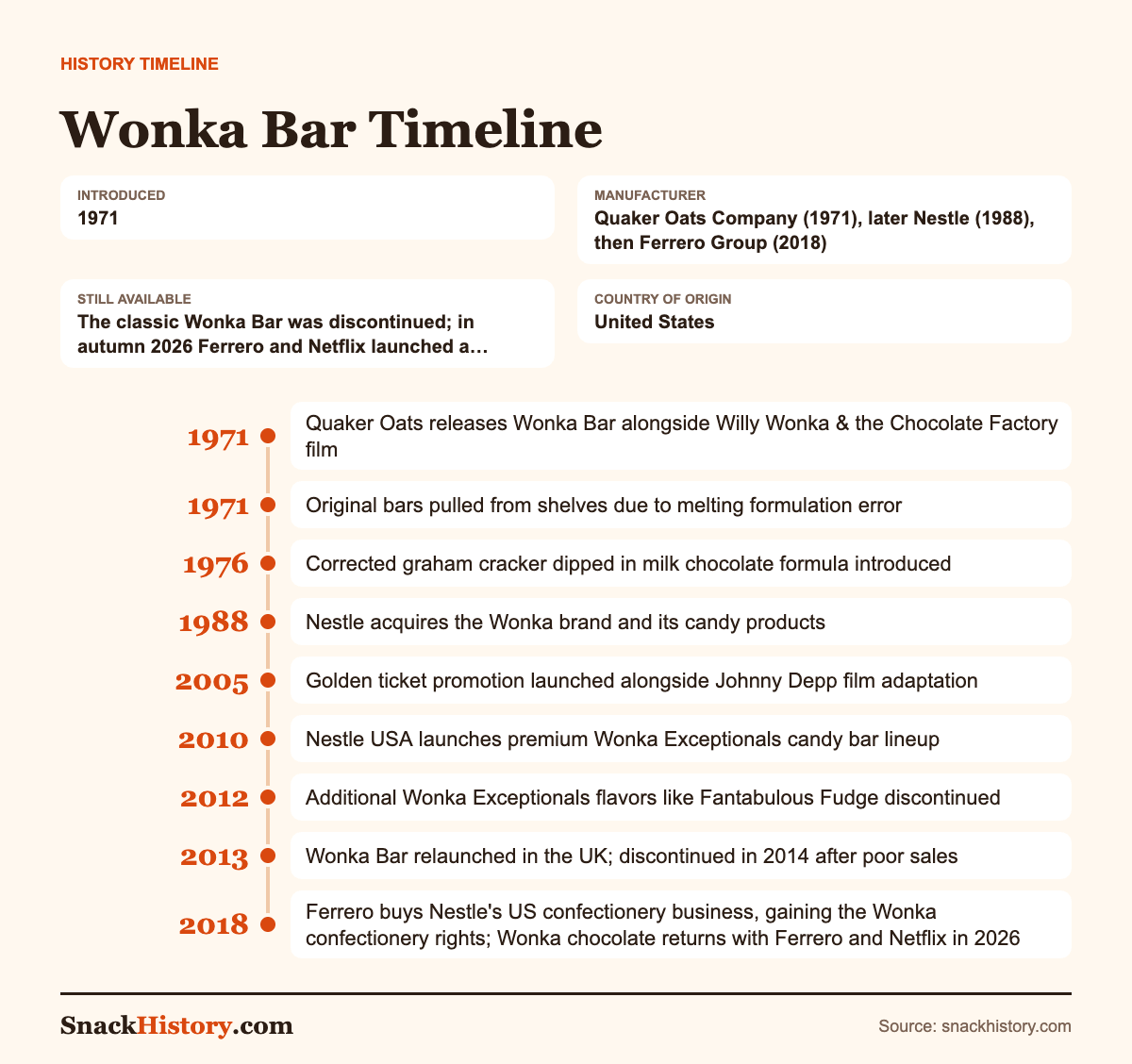
Wonka Bar Timeline
- 1971 — Quaker Oats releases Wonka Bar alongside Willy Wonka & the Chocolate Factory film
- 1971 — Original bars pulled from shelves due to melting formulation error
- 1976 — Corrected graham cracker dipped in milk chocolate formula introduced
- 1988 — Nestle acquires the Wonka brand and its candy products
- 2005 — Golden ticket promotion launched alongside Johnny Depp film adaptation
- 2010 — Nestle USA launches premium Wonka Exceptionals candy bar lineup
- 2012 — Additional Wonka Exceptionals flavors like Fantabulous Fudge discontinued
- 2013 — Wonka Bar relaunched in the UK; discontinued in 2014 after poor sales
- 2018 — Ferrero buys Nestle’s US confectionery business, gaining the Wonka confectionery rights; Wonka chocolate returns with Ferrero and Netflix in 2026
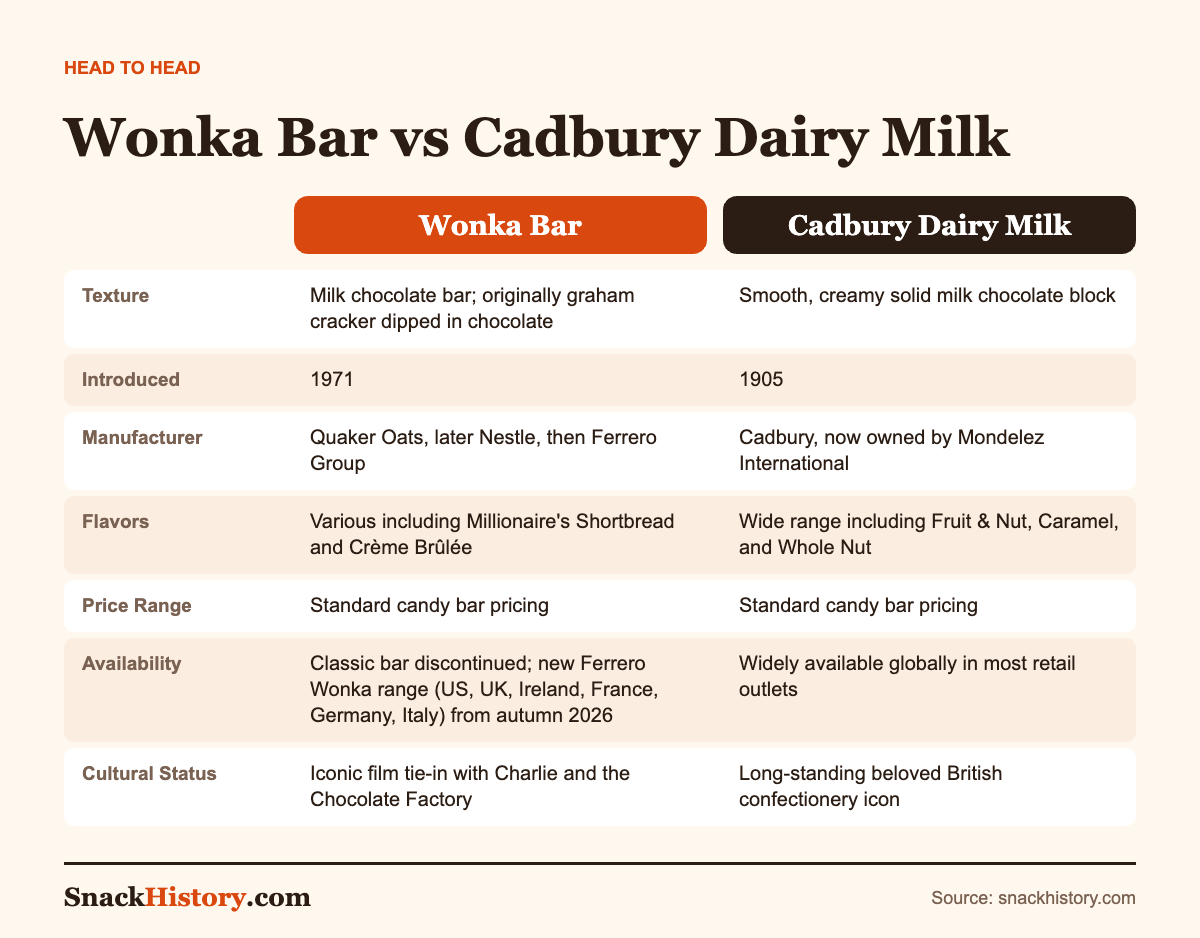
Wonka Bar vs Cadbury Dairy Milk
| Feature | Wonka Bar | Cadbury Dairy Milk |
|---|---|---|
| Texture | Milk chocolate bar; originally graham cracker dipped in chocolate | Smooth, creamy solid milk chocolate block |
| Introduced | 1971 | 1905 |
| Manufacturer | Quaker Oats, later Nestle, then Ferrero Group | Cadbury, now owned by Mondelez International |
| Flavors | Various including Millionaire's Shortbread and Crème Brûlée | Wide range including Fruit & Nut, Caramel, and Whole Nut |
| Price Range | Standard candy bar pricing | Standard candy bar pricing |
| Availability | Classic bar discontinued; new Ferrero Wonka range (US, UK, Ireland, France, Germany, Italy) from autumn 2026 | Widely available globally in most retail outlets |
| Cultural Status | Iconic film tie-in with Charlie and the Chocolate Factory | Long-standing beloved British confectionery icon |
Logo

Ingredients
From the listing for the Scrumdiddlyumptious bar which was similar to the original Wonka Bar:
- Sugar
- Cocoa Butter
- Chocolate
- Nonfat milk
- Peanuts
- Milkfat
- Lactose
- Butter
- Rice flour
- Less than 1% of palm oil, so lecithin, corn flour, modified cornstarch
- Salt
- Natural flavors
- High fructose corn Syrup
Nutrition
| Serving Size: | 1 bar | % Daily Value* |
| Amount Per Serving | ||
| Calories | 360 | |
| Calories from Fat | 170 | |
| Total Fat | 19g | 29% |
| Saturated Fat | 11g | 55% |
| Trans Fat | 0g | |
| Cholesterol | 10mg | 3% |
| Sodium | 85mg | 4% |
| Potassium | 0mg | 0% |
| Total Carbohydrate | 49g | 16% |
| Dietary Fiber | 2g | 8% |
| Sugars | 40g | |
| Protein | 4g | 8% |
| Vitamin A | 0% | |
| Vitamin C | 0% | |
| Calcium | 0% | |
| Iron | 0% |
- Percent Daily Values are based on a 2,000 calorie diet. Your daily values may be higher or lower depending on your calorie needs.
Varieties
- Original Wonka Bar
- Wonka Xploder
- Wonkalate
- Wonka Biscuits
- Whipple-Scrumptious Fudgemallow Delight
- Nutty Crunch Surprise
- Triple Dazzle Caramel
- Edible Garden
- Eureka Moment
- Happy Go Lucky
- Wonka Exceptionals
- Wonka Chocolate Waterfall Bar
- Wonka Fantabulous Fudge
- Crème Brule
- Chocolate Nice Cream
- Millionaire’s Shortbread
- Chocolate Tales Bar
- Caramel Hat Trick
- Wonka Triple Chocolate Whipple Bar
- Nutty Crunchilicious
- Cookie Creamery
- Mudpuff Caramel Stuff
Not all of these flavors were sold in the US and many of them were specifically made for unique candy types like the Exceptionals lineup. Most of these bars were not sold in varying sizes either and you might find that one or another of them were only sold as mini bars while others were only sold as large bars. The changes that constantly plagued the Wonka brand name created many spin-offs in other countries that were never marketed anywhere else.
Most of these flavors or varieties of candies were sold for a year or less at a time and then never showed up on the scene again. Some of them were versions of previous flavor offerings with a few new ingredients thrown in or a few added layers or other candy types. It would be difficult to track down any of these candies these days with an original wrapper or in all of these flavors. The various markets that were involved in selling them combined with the way that distribution and marketing were done have made sure that most of these candy bars barely saw the light of day before being pulled from shelves.
Pictures

Commercials
A 2005 ad:
One of the later ads from the Nestle era of the Wonka brand:
A 1971 ad:
Frequently Asked Questions about Wonka Bar
Who originally made the Wonka Bar?
The Wonka Bar was originally created by the Quaker Oats Company, which released it in 1971 alongside the film Willy Wonka & the Chocolate Factory. Quaker Oats had actually funded much of the movie's production specifically to promote their new candy products. The brand was later acquired by Nestle in 1988.
Why was the original Wonka Bar discontinued?
The original 1971 Wonka Bar was pulled from shelves almost immediately after launch due to a formulation error that caused the bars to melt too easily. Despite heavy marketing tied to the film's release, the candy could not remain stable enough for retail sale. A corrected formula was eventually introduced, with a graham cracker dipped in milk chocolate version appearing by 1976.
Did Wonka Bars ever have real golden tickets inside?
Yes, Nestle included real golden tickets in Wonka Bars on two notable occasions. In 2005, tied to the Johnny Depp film adaptation, five golden tickets were hidden across five Wonka products, and the one in the Wonka Bar was worth a $10,000 cash prize. In 2010, Nestle's Wonka Exceptionals line included ten golden tickets, with winners receiving a trip around the world.
What flavors did Wonka Bars come in?
Over the years, Wonka Bars appeared in several varieties. The 2013 comeback bars were sold in Millionaire's Shortbread, Crème Brûlée, and Chocolate Nice Cream flavors, though these were not sold in the United States. The 2010 Wonka Exceptionals line also included a Scrumdiddlyumptious Chocolate Bar, a Wonka Chocolate Waterfall Bar, and a Wonka Domed Dark Chocolate Bar.
Are Wonka Bars still available to buy?
Yes again. The classic Quaker and Nestle Wonka Bars are long gone, and the 2013 UK revival was dropped after poor sales, but in autumn 2026 Ferrero and Netflix launched a new Wonka range in the US, UK, Ireland, France, Germany and Italy. It includes the Wonka Purplypurple Milk Chocolate Bar, and packs carry a QR-code golden ticket game. The products are described as seasonal and limited edition, so availability may vary by store and season.
When did the Wonka Bar come out?
The Wonka Bar came out in 1971, released by Quaker Oats alongside the film Willy Wonka & the Chocolate Factory. Quaker funded much of the film to promote the candy.
Who owns the Wonka brand now?
The Ferrero Group has owned the Wonka brand since 2018, when it bought the branding and production rights from Nestlé. Nestlé had owned Wonka since 1988.


Bought a wonka bar with a golden ticket in irelabd may 5, 2022. Some of the bars can still be bought in other places besides usa. And of course, the Candy Box in Ireland does ship to USA quite often.