

Hard Candy: History, Flavors & Brands

Quick answer: Hard candy dates back to ancient honey-based sweets in Egypt and sugarcane candy in India, with modern hard candies appearing in the 16th century. Peppermint and lemon drops were early flavors, and brands like Spangler and Brach’s still make it today.
Our childhood memories are strongly linked to hard candy. Halloween, Christmas, Easter, birthdays, and all other special days are almost unimaginable without these sweet treats. Can you even think of your grandma’s house without a bowl of delicious treats in it? We bet this sounds familiar to you! And considering this, we can say that hard candy is the most admired and cherished candy among all.
| Hard Candy | Facts |
|---|---|
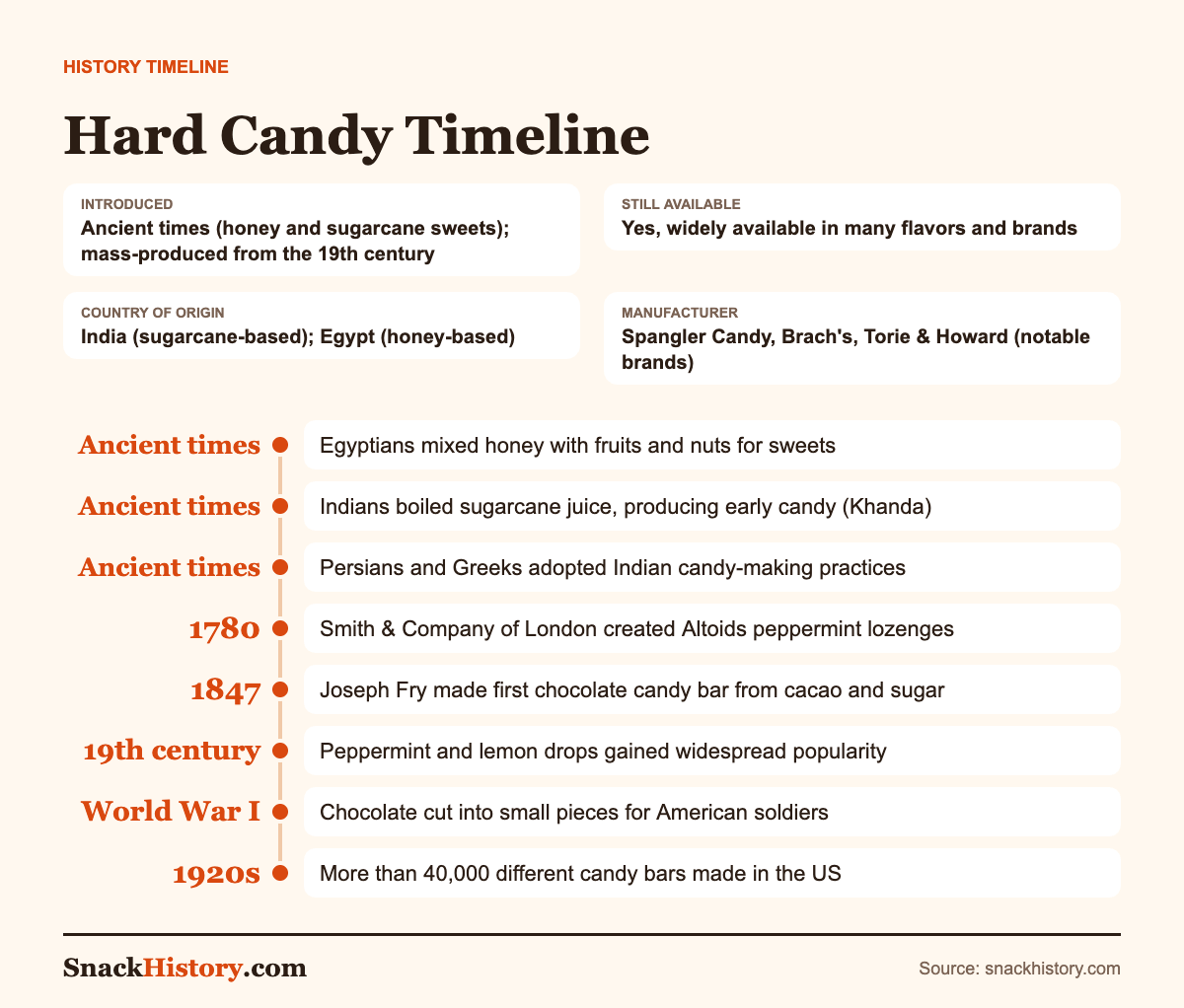
| Introduced | Ancient times (honey and sugarcane sweets); mass-produced from the 19th century |
| Candy Type | Hard candy (boiled sweets) |
| Original Flavors | Peppermint and lemon drops |
| Still Available | Yes, widely available in many flavors and brands |
| Country of Origin | India (sugarcane-based); Egypt (honey-based) |
| Manufacturer | Spangler Candy, Brach's, Torie & Howard (notable brands) |
| Key Ingredients | Sugar (sucrose, glucose, or fructose), flavorings, colorings, plant extracts |
| Parent Company | Various; no single parent company across all hard candy brands |
The Origins of Hard Candy
Sweets made by boiling honey or sugar go back thousands of years. As sugar became cheaper and more widely traded in Europe from the 1500s onward, sugar confectionery spread beyond the tables of the wealthy, and by the 19th century new machinery and cheap sugar let manufacturers mass-produce hard candy and experiment with new shapes, flavors and colors.
In South Asia, the sweet treats were made by boiling sugarcane juice and consuming Khanda. The word “candy” comes from “khanda”. This practice was especially widespread in India. Other cultures, such as the Persians and Greeks, later discovered that Indians were producing “honey without the bees.” After that, they adopted this practice and started candy-making.
The manufacturing process was specially raised during World War I. Chocolate was then cut into smaller pieces and distributed to the American soldiers. By the end of the 1920s, more than 40,000 different candy bars were being made in the US.
Our favorite treats started to gain popularity in the 19th century. Peppermints and lemon drops were two of the first loved and most famous hard candies. And the first chocolate candy bar was made by Joseph Fry in 1847. It was made of cacao butter, cocoa, and sugar.
Hard Candy Timeline
- Ancient times — Egyptians mixed honey with fruits and nuts for sweets
- Ancient times — Indians boiled sugarcane juice, producing early candy (Khanda)
- Ancient times — Persians and Greeks adopted Indian candy-making practices
- 1780 — Smith & Company of London created Altoids peppermint lozenges
- 1847 — Joseph Fry made first chocolate candy bar from cacao and sugar
- 19th century — Peppermint and lemon drops gained widespread popularity
- World War I — Chocolate cut into small pieces for American soldiers
- 1920s — More than 40,000 different candy bars made in the US
Hard Candy vs Jolly Rancher Hard Candy
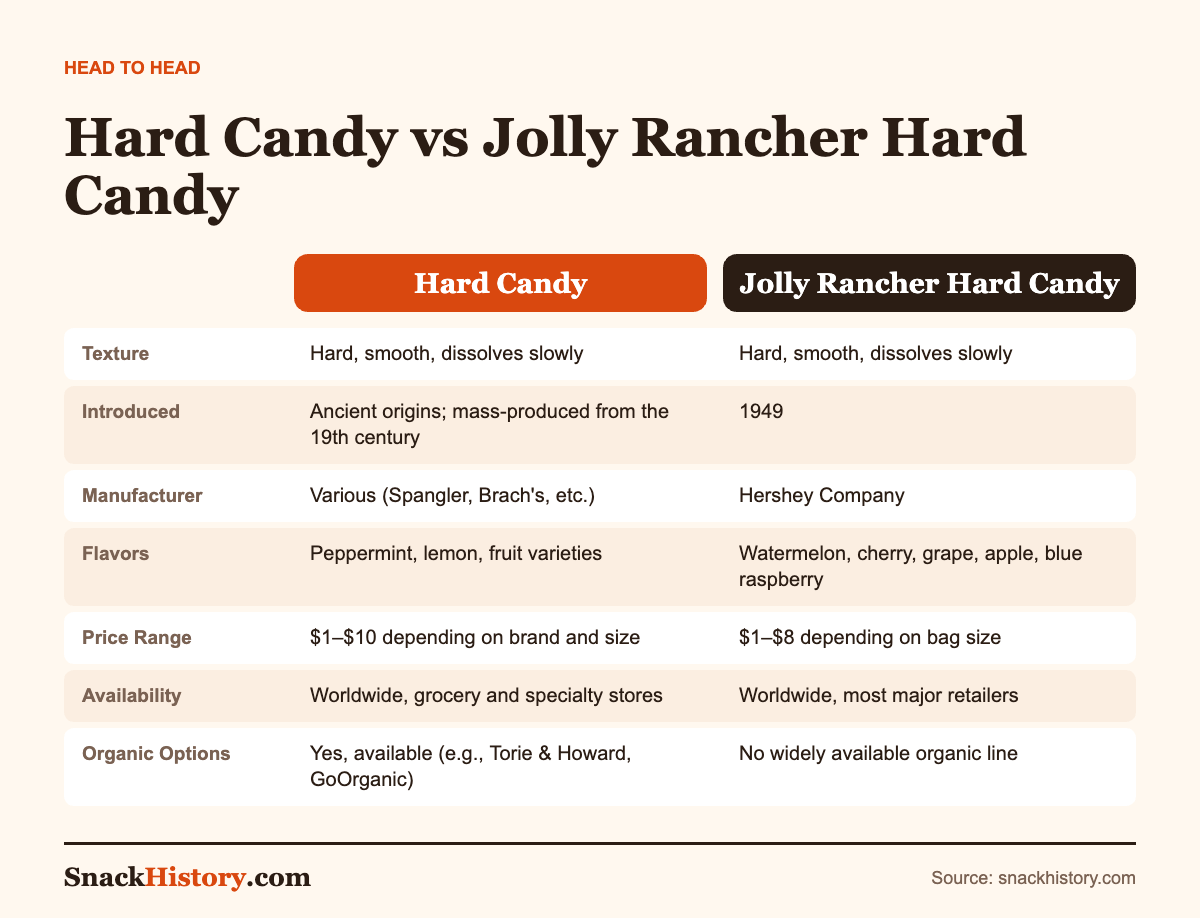
| Feature | Hard Candy | Jolly Rancher Hard Candy |
|---|---|---|
| Texture | Hard, smooth, dissolves slowly | Hard, smooth, dissolves slowly |
| Introduced | Ancient origins; mass-produced from the 19th century | 1949 |
| Manufacturer | Various (Spangler, Brach's, etc.) | Hershey Company |
| Flavors | Peppermint, lemon, fruit varieties | Watermelon, cherry, grape, apple, blue raspberry |
| Price Range | $1–$10 depending on brand and size | $1–$8 depending on bag size |
| Availability | Worldwide, grocery and specialty stores | Worldwide, most major retailers |
| Organic Options | Yes, available (e.g., Torie & Howard, GoOrganic) | No widely available organic line |
How Hard Candy is Produced?
Hard candy (also called boiled sweets) traces back to the ancient Egyptians. They used honey and mixed it with different kinds of fruit and nuts. However, honey was also widely used by the Greeks to make sweet treats with fruits and flowers.
Currently, most hard candies are sugar-based. The sugar gets heated to the hard-crack stage, roughly 150 °C (300 °F). Either sucrose, glucose, or fructose sugar syrup is made. After that, some additional ingredients are added. such as plant extracts, essential oils, colorings, flavorings, and others. In the end, the syrup is poured into the mold, cools down, and hardens.
Most Famous Hard Candy
Peppermint Candy

Who can imagine a holiday party without red and white striped, minty-flavored treats? In fact, Peppermint Hard candy is an iconic symbol of Christmas which is why candy lovers around the world adore these Christmas candies.
The exact origin of peppermint candy is not clear. Mint has been used since ancient times to settle the stomach, and peppermint itself is a natural hybrid of watermint and spearmint. It was being grown commercially in England, around Mitcham in Surrey, by the mid-1700s, which made peppermint oil easy to get for sweet makers.
One of the best-known early peppermint sweets is Altoids, whose origins are traced to around 1780 in London, where they were sold to relieve intestinal discomfort. In Austria, Eduard Haas created PEZ in 1927 as a pressed peppermint candy. Today there are many varieties and shapes of peppermint candy, and Spangler Candy is one of the best-known makers of traditional red and white peppermint candy canes.
Peppermint candy canes have been a significant part of our Christmas celebrations for generations now. It became a holiday staple and a cultural phenomenon, the source of many sweet memories.
Lemon Drops

Lemon Drops are one of the most famous hard candies. With its name, we can guess that the candy has a lemon flavor and that the color is yellow, often shaped like a lemon. Candy can have a sour taste or a sweeter taste too.
It is made by boiling sugar with water and tartar cream. When it cools down, the lemon flavor is added. After that, the candy is rolled in sugar and the shape is determined.
Lemon drops have been popular in Britain and the United States since at least the 19th century. The acid in the recipe (cream of tartar, and in some recipes citric acid) helps stop the boiling sugar from crystallizing, which keeps the candy clear and glassy. Many brands make lemon drops today; in the US, Brach’s is one well-known name.
Top Organic Hard Candies
Lemon and Raspberry Organic Hard Candy

Lemon and Raspberry hard candy is made by Torie & Howard , an organic candy brand co-founded by Torie Burke and Howard Slatkin and later acquired by American Licorice Co.
Torie & Howard’s candies are USDA Organic and kosher certified, and the brand describes them as non-GMO, vegan, gluten-free and allergen friendly. The hard candies have been sold in small tins.
This candy has sweet and sour lemon and raspberry flavors. Also, additional flavors include pomegranate and nectarine, or blood orange and honey.
GoOrganic Organic Hard Candies

GoOrganic hard candies come from the Go Naturally family of organic candies and are made in the USA. The assorted bag has included fruit flavors such as Strawberry, Pomegranate and Cherry, and the line has also offered flavors like Honey Lemon and Iced Mint Mango.
The candies are made with organic ingredients and contain no artificial flavors or colors. Retailers list them as gluten-free and kosher certified; check the bag for the latest certifications and allergen information.
Holiday Candy Assortment

The Holiday Candy Assortment is an assortment of favorite candies from generations past. Originally, the candy was made and introduced in 1949, but it’s generally considered a ‘50s candy. The Creator was the Jolly Rancher Company in Colorado, owned by Bill and Dorothy Harmsen. Currently, the Hershey company owns the brand.
Jolly Ranchers’ hard candies are especially popular with people because of their variety of flavors. There are different types of small, bite-sized candies in the assortment. including raspberry, grape, watermelon, and apple. These hard candies are individually wrapped, so they are made to be shared with loved ones. And one more thing, the candy contains no cholesterol or fat, although it is made mostly of sugar and corn syrup.
Old-Fashioned Hard Candy
Root Beer Barrels

Root Beer Barrels can be considered as one of those old-fashioned candies. Hard Candy is manufactured by F.B. Washburn Candy Company. The company is considered to be one of the oldest family-owned businesses in the United States. They are located in Massachusetts and have been on the market since 1856.
Root Beer has a very distinct flavor, and it is the most authentically American flavor available. While eating these dark-colored candies, the delicious root beer flavor bursts and fills the head with happiness and memories.
Washburn’s Old-Fashioned Hard Candies

Washburn’s company is based in Massachusetts and has been the producer of one of the best hard candies on the market. The candy is specially designed so that it creates the Christmas spirit and feeling. It has been in our homes or generations, and just looking at it can bring up many memories. There was always a supply of Washburn’s hard candies in our grandmas’ houses, and it made the environment even warmer and more relaxing.
The candies are located in a 16-ounce container. There are different types of delicious treats mixed together. They differ in shape, color, and flavor.
LifeSavers Hard Candy

Lifesavers is a classic American hard candy that has been around since 1912. The package contains five different flavors, including Raspberry, Watermelon, Cherry Pineapple, and Orange.
Candies are shaped like hoops and have an empty circle in the middle. Packaging has beautiful, eye-catching, vibrant colors. Different fruits are shown on it, and it is see-through. With just a look at the package, one would want to just taste it and enjoy the sweet fruity taste.
Sweet Adventure of Hard Candy
Classic Guava Hard Candy

Classic Guava Hard Candy is not known to everybody. But it is often given in Chinese restaurants at the end of the meal and therefore, tends to be one of the most exotic Chinese candies. If you taste it once, then you will absolutely fall in love with it.
The best-known version in the US is the Classic Series guava candy sold under the Hongyuan brand from China. It has a sweet, fruity guava flavor and aroma, and the pieces come individually wrapped.
Watermelon Hard Candy

Another healthy hard candy is Jolly Rancher’s Watermelon Hard Candy. Candy is actually fat-free and cholesterol-free. Candy comes in individual wrappings.
Watermelon hard candy is truly a classic. The sweet watermelon taste affects the receptors greatly and creates a taste celebration in the mouth. The wrapping is designed beautifully. There is a smiley watermelon looking at us from the wrapping and giving us great, positive vibes.
Werther’s Original Hard Candies

If you love caramel, then Werther’s Original Hard Candies are for you. Actually, this sweet treat is made with real butter and real cream. Candy is absolutely gluten-free. It’s a classic German candy that’s considered a retro treat.
The brand takes its name from the town of Werther in Westphalia, Germany, where confectioner Gustav Nebel created the butter candy in 1909 at the August Storck company, which still makes Werther’s Original today.
Candy melts in the mouth while eating and creates a creamy and delicious taste. They are individually wrapped.
Atomic Fireballs

Shoutout to Cinnamon Lovers. There is a candy just for you, one that will satisfy all your needs and wishes. Fireballs Candy, known by all and very famous, is produced by Ferrara Pan Brand. Candy is fat-free and gluten-free too. Candy consists of little, bite-sized, red balls that are individually wrapped.
The candy was created by Nello Ferrara in 1954, who was the son of Salvatore Ferrara. He wanted to develop spicy candies. This hot panned candy was created using the hot candy process.
Spicchi-Italian Hard Candy

Let’s travel to Italy now. One of the best-known Italian hard candies in the US is Spicchi, citrus-wedge candies often sold as Spicchi Sorrento. They have long been sold under the Perugina name, and today the Italian confectioner Fida makes a widely sold version.
Bags typically weigh around 2.2 pounds (1 kg) and hold lots of individually wrapped candies. They are gluten-free and come in orange, lemon and tangerine flavors with orange and yellow wrappers.
Charms Sweet N Sour Pops

Sweet N Sour Pops will open up your taste buds and can cure any sweet tooth. Each Charms pop pairs a sweet flavor with a sour one, so every lick is a blend of sweet and tangy. They are sold in boxes and bags of individually wrapped pops, and the flavor pairings vary by assortment.
These lollipop candies are especially loved by children and are a great treat for Halloween and the decoration of Easter baskets.
Blueberry Candy Sticks

Blueberry candy sticks are the most “blue” candy you have ever seen. They are blue and taste of blueberries, so blueberry fans, this one is for you. They are usually sold by the box, with each stick individually wrapped.
The sticks come in light and dark blue, and they leave your tongue with a blue tint. Check the box for size and certification details, which vary by brand.
Bottom Line
Now you can see that hard candy is one of the most popular types of candy on the market today. It is widely used and purchased, especially on special occasions and celebrations. It is a great treat for family and loved ones. Also, hard candies are an important part of parties, and you can see them at many offices and receptions.
Starting with peppermint candies and ending with lemon drops, we may not notice, but hard candies have a very important part in our lives. Tastes are strongly linked to our childhood, home, celebrations, and grandparents, and this has been the case for generations. Who can imagine Halloween without hard candy? Or Christmas without beautiful peppermint canes?
Which hard candy is bringing us beautiful memories of your childhood? Share your thoughts and sweet memories with us in the comments below.
Frequently Asked Questions about Hard Candy
Where does the word 'candy' come from?
The word 'candy' originates from the word 'Khanda,' which referred to the practice of boiling sugarcane juice in South Asia, particularly in India. Other cultures, including the Persians and Greeks, later discovered this practice and adopted candy-making from the Indians, who were famously described as producing 'honey without the bees.'
How is hard candy made?
Hard candy is made by heating sugar to roughly 150 °C (300 °F) to create a syrup using sucrose, glucose, or fructose. Additional ingredients such as plant extracts, essential oils, colorings, and flavorings are then added to the syrup. Finally, the mixture is poured into molds, allowed to cool, and hardens into its final form.
What were the first popular hard candy flavors?
Peppermint and lemon drops were two of the first loved and most famous hard candy flavors, gaining popularity in the 19th century. Altoids peppermints date back to around 1780 in London, and lemon drops get their clear, glassy texture partly from the acid in the recipe, which helps stop the sugar from crystallizing.
What makes organic hard candy different from regular hard candy?
Organic hard candy is made with certified organic ingredients, such as organic cane sugar and natural flavors and colors, and avoids GMO ingredients. Brands like Torie & Howard carry USDA Organic certification and also market their candies as vegan and allergen friendly. Organic hard candy is still mostly sugar, though, so it is a treat rather than a health food.
What is the history of peppermint candy canes?
One of the best-known early peppermint candies, Altoids, dates to around 1780 in London, when it was sold to relieve intestinal discomfort. Eduard Haas of Austria later invented peppermint Pez Candy, and today brands like Spangler Candy produce traditional red and white peppermint candy canes along with new variations, making them a beloved Christmas holiday staple.
When were Altoids created?
Altoids peppermint lozenges were created in 1780 by Smith & Company of London. They are among the oldest hard candy brands, alongside classic peppermint and lemon drops, which were the earliest popular flavors.
What is hard candy made of?
Hard candy is made mainly from sugar, such as sucrose, glucose or fructose, plus flavorings, colorings and sometimes plant extracts.


Related Posts
Trident Gum: History, Ingredients & Facts
Snack History Nostalgia RatingBig on nostalgia ★★★★★4/5 Quick answer: Trident gum was introduced in 1960 and commercially marketed from 1964 as a sugar-free chewing…
Read more
Warheads Candy: History, Flavors & Facts
Snack History Nostalgia RatingFond memories ★★★★★3/5 Quick answer: Warheads came out in 1975 in Taiwan and were imported into the United States in 1993.…
Read more
Reese’s Fast Break: History, Packaging & Facts
Snack History Nostalgia RatingA little nostalgic ★★★★★2/5 Quick answer: Reese’s Fast Break is a Hershey candy bar of milk chocolate, peanut butter and nougat,…
Read more