

After Eight Mints: History, Ingredients & Flavors

Quick answer: After Eight mints were introduced in 1962 by Rowntree in the United Kingdom and are now made by Nestlé in Halifax, UK. The peppermint-filled dark chocolate thins are still widely sold in the UK, US and Europe.
The real name of this candy product is After Eight Mint Chocolate Thins, but most people know them as, “After Eights”. This product is really well-known in the UK, but it is also sold in the US. Chocolate after dinner mints like this are always really popular, but this mint product stands out more than others on the market. The After Eight mint does not ooze or run when bitten into, a design feature that will remind you of York Peppermint Patty products.
After Eight Mints were sold in the original recipe version for many years but some people in the US are more familiar with some of the alternate flavors of this product that are offered in the US. If you love minty chocolate treats, this is a really good choice to make.
| After Eight Mints | Facts |
|---|---|
| Introduced | 1962 |
| Manufacturer | Nestlé (formerly Rowntree Company Limited) |
| Candy Type | Mint Chocolate Thins |
| Original Flavors | Peppermint with dairy-free dark chocolate |
| Still Available | Yes, widely available in the UK, US, and Europe |
| Country of Origin | United Kingdom |
| Parent Company | Nestlé |
| Current Production Location | Halifax, UK (since Castleford factory closed in 2012) |
| Nostalgia rating | 4/5 (Big on nostalgia) |
History
After Eight Chocolate Mint Thins are often known as “After Eights”. They were created by Rowntree Company Limited in 1962. They have been manufactured by Nestle since they acquired the Rowntree company in 1988. The mints were originally crafted at Rowntree’s York location and then later Castleford in West Yorkshire.
The creator of After Eight mints was Brian Sollitt. He also made other well-known products like Yorkie Bars, Matchmakers, and Lion Bars. He enjoyed a long career at Rowntree’s, but his most memorable product is the After Eight. He was recruited by the company at 15 to hand pipe Black Magic chocolates. By the 1960s he was asked to come up with new flavors and varieties of the chocolates that the company was already making.
The timing of his creation was perfect because the 60s were a time when the middle class was reaching for a better future with more style and class. After Eight mints became associated with luxurious living and their excellent flavor and affordable price point helped to confirm their popularity. Nearly all of the ads for this product were associated with good taste, luxurious living, and a leisurely way of life.
Chocolate products also were finally able to survive summer weather due to refrigerators and climate control in buildings. Chocolate products had always been a bit impractical for companies selling candies because of the melting point of chocolate. Chocolate products were necessarily luxurious because it was hard to keep them fresh and edible, especially during the hottest part of the year. This made chocolate products a perfect vehicle for this sense of luxury and lush living because it was so affordable and brought with them this former glory related to extravagant living.
In the UK, After Eights are currently made in Halifax because the Castleford factory closed in 2012. The original recipe included dairy-free dark chocolate, but since 2002, butterfat has been added to the recipe by Nestle because of the risk of chocolate bloom. Chocolate bloom happens when chocolate gets a dusty appearance. This is caused when the chocolate is exposed to heat or warm temperatures and the surface of the chocolate changes.
Chocolate bloom will not make your candy unsafe to eat, but it can impact the texture and flavor of the product. This is particularly common with chocolates that are quite thin and chocolates without the standard butterfat or sugar content. Dark Chocolate blooms fairly easily, and Nestle decided that there was no need to continue with the original recipe if it was going to be susceptible to this kind of outcome when After Eight mints got too warm. Since After Eight mints are so thin, when a chocolate bloom happens, all of the layers of the chocolate can become dusty, gritty, and flaky. The texture of this product is everything so avoiding chocolate bloom is important.
These mints are sold across the US and Europe and Nestle states that they make one billion of these mints each year. The fondant that is in the center is flavored with mint or might be flavored with another flavoring for alternate varieties. The fondant is made with a small amount of the enzyme invertase. The firm fondant is coated in chocolate, and over the following days the enzyme gradually breaks down some of the sugar, turning the centre soft and creamy. The mints are then wrapped individually and sold in large boxes to businesses that sell these mints.
These mints are certified kosher, but they no longer meet the vegan requirements due to the butterfat that has been added to the recipe by Nestle. This mint is a bit bigger than other similar mint products on the market and the texture is smoother than some of the other mints that are made with a similar flavor profile.
Once Nestle came into the picture, new flavors were added to the mix. Thin mints were added that came in orange, lemon, strawberry, blackcurrant, and more. There are also marzipan products that are sold in Germany. Straws, Delights, and other versions of this candy are sold in some marketplaces as well. There are seasonal products too, so you can get your After Eights in various different formats during specific seasons and holidays.
After Eight Mints was not part of the group of US candy brands that Nestlé sold to Ferrero in 2018, so the brand remains with Nestlé and the classic recipe has not been handed to a new owner.
Nestle still shows the product on their website and they still advertise that you can get the mints in bulk format for restaurants and hotels or even wholesalers. Their seasonal products are still listed in the items that they offer as well. This is a good sign for lovers of these products who are concerned that they might be going away.
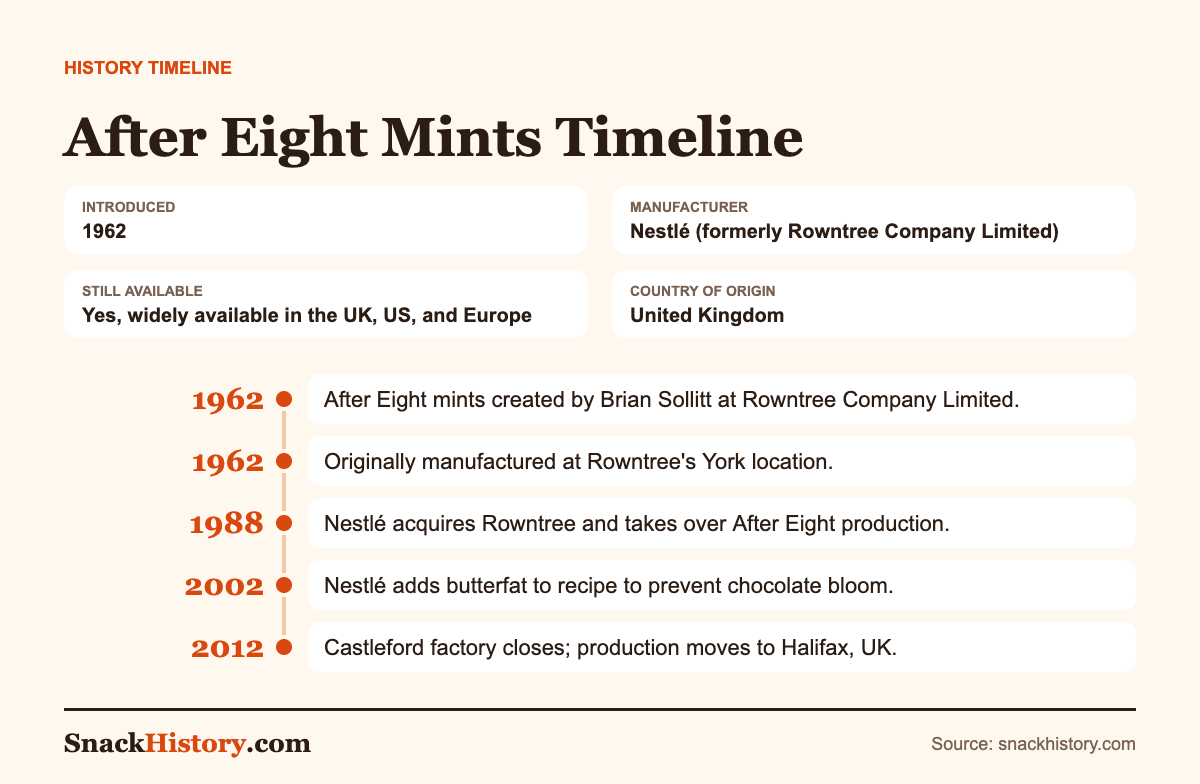
After Eight Mints Timeline: Key Dates Since 1962
- 1962 — After Eight mints created by Brian Sollitt at Rowntree Company Limited.
- 1962 — Originally manufactured at Rowntree's York location.
- 1988 — Nestlé acquires Rowntree and takes over After Eight production.
- 2002 — Nestlé adds butterfat to recipe to prevent chocolate bloom.
- 2012 — Castleford factory closes; production moves to Halifax, UK.
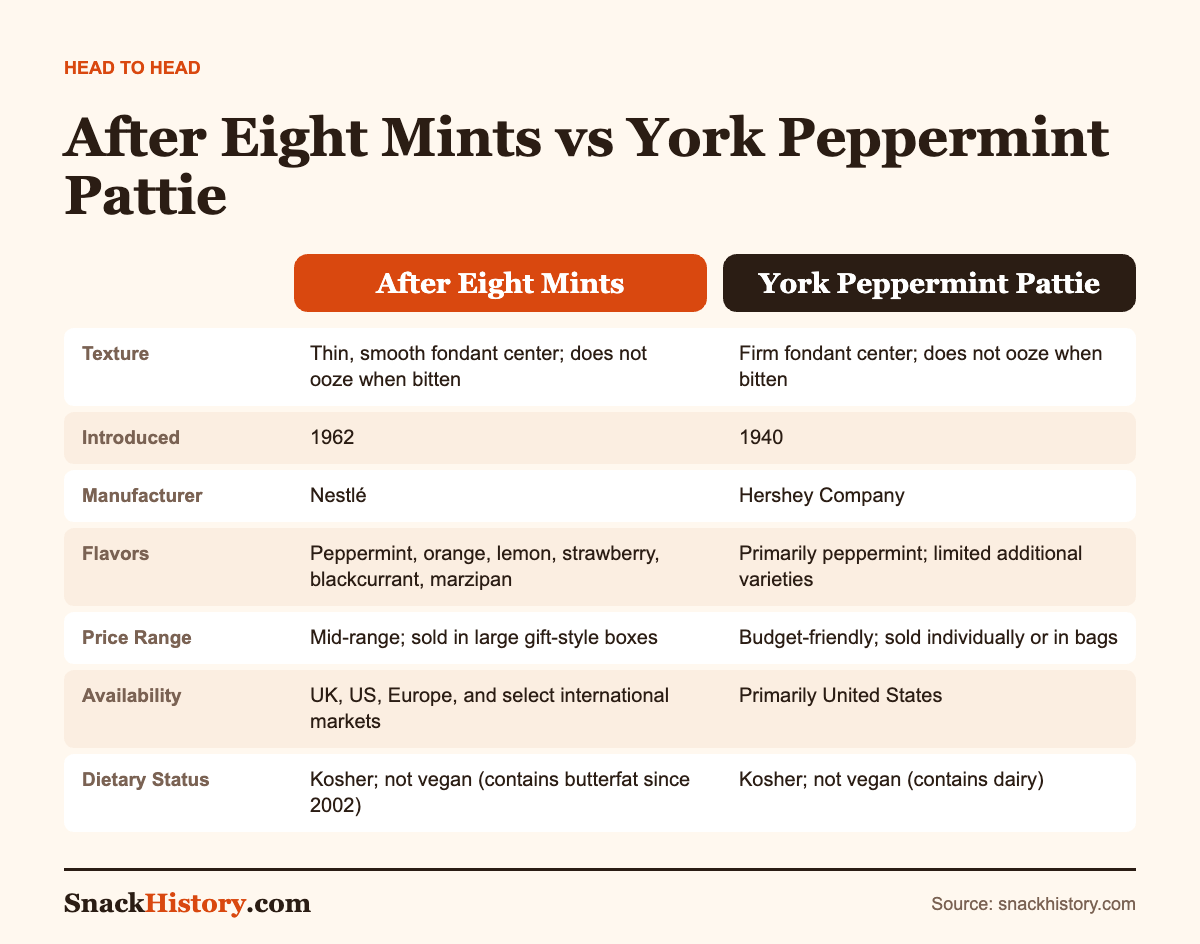
After Eight Mints vs York Peppermint Pattie
| Feature | After Eight Mints | York Peppermint Pattie |
|---|---|---|
| Texture | Thin, smooth fondant center; does not ooze when bitten | Firm fondant center; does not ooze when bitten |
| Introduced | 1962 | 1940 |
| Manufacturer | Nestlé | Hershey Company |
| Flavors | Peppermint, orange, lemon, strawberry, blackcurrant, marzipan | Primarily peppermint; limited additional varieties |
| Price Range | Mid-range; sold in large gift-style boxes | Budget-friendly; sold individually or in bags |
| Availability | UK, US, Europe, and select international markets | Primarily United States |
| Dietary Status | Kosher; not vegan (contains butterfat since 2002) | Kosher; not vegan (contains dairy) |
Logo

After Eights Products
- Thin Mints
- Marzipan- Sold in Germany
- Mint & Blood Orange -special edition sold only in the summer of 2011
- Delights- round candies with dark chocolate mint fondant filling
- Straws- Long, thin sticks of soft dark chocolate with mint fondant filling
- Bars- dark chocolate bar with creamy mint center
- Biscuits- dark chocolate with mint inside a biscuit
- Chocolate Santa Claus – white or dark chocolate
- Easter Bunny- peppermint-flavored chocolate
- Bitesize- plain chocolate with mint filling also sold under the name Mintola and Mint Munchies before being purchased by After Eight.
- Mousse
- Dessert
- Strawberry and Mint- Special edition for spring and summer of 2020
Some products have been fully discontinued:
- Chocolate truffles
- Dark chocolate Irish creams
- Ice cream dessert
Ingredients
From the Nestle listing for the product:
- Sugar
- Cocoa mass
- Glucose syrup
- Cocoa butter
- Butterfat (from milk)
- Emulsifier (sunflower lecithin)
- Natural peppermint oil
- Citric acid
- Stabilizer (invertase)
Nutrition
| Serving Size: | 1 mints (8.5g) | % Daily Value* |
| Amount Per Serving | ||
| Calories | 37.5 | |
| Total Fat | 1.1g | 2% |
| Saturated Fat | 0.6g | 3% |
| Trans Fat | 0g | |
| Cholesterol | 0mg | 0% |
| Sodium | 0mg | 0% |
| Total Carbohydrates | 6.5g | 2% |
| Dietary Fiber | 0.3g | 1% |
| Sugars | 5.8g | |
| Includes Added Sugars | 5.5g | 11% |
| Protein | 0.1g | |
| Vitamin D | 0mcg | 0% |
| Calcium | 0mg | 0% |
| Iron | 0mg | 0% |
| Potassium | 20mg | 0% |
- The % Daily Value (DV) tells you how much a nutrient in a serving of food contributes to a daily diet. 2000 calories a day is used for general nutrition advice.
Similar Products to After Eights
There are other products on the market that are a lot like this after-dinner mint. Royal Mints were made by a company called Halloren to compete with After Eights. Mint Nights was another product that was intended to be a competitor that was made by Poundland. After Dinner Mints were made in Australia to compete with After Eights as well. These mints are made by a company called Red Tulip which was bought by Cadbury in the 1980s.
Livery
After Eight Mints still continues to be associated with upper-class living. The boxes for this mint are very beautiful and the dark green background and the fancy white lettering are very complementary. The box shows the mint itself and then all the writing is clustered around the image. The marketing that is offered by this kind of upscale appearance is very clearly associated with the brand vision for this product.
The After eight mints themselves are all individually wrapped. The wrappers are dark brown for the original flavor and there is a light gold scrolling design on the wrapper. There is a sense of mystery about the product communicated by the livery as a whole. This is one of the most unique candy brands on the market because of this classy, understated, and elegant styling.
The variations of this product that are flavored such as the mint & blood orange, are sold in the same classic box but with an orange ribbon design around the box and next to the image of the chocolate on the front of the box. The styling is remarkably consistent between the various varieties of this candy which is not typical for a candy company.
Pictures


Ads:
An ad from the 80s:
An ad from the 70s:
A collection of older ads:
Another classic ad:
Frequently Asked Questions about After Eight Mints
Who invented After Eight mints?
After Eight mints were created by Brian Sollitt while working at Rowntree Company Limited. Sollitt was originally recruited by the company at age 15 to hand pipe Black Magic chocolates, and by the 1960s he was tasked with developing new flavors and varieties. He also created other well-known products such as Yorkie Bars, Matchmakers, and Lion Bars.
Why did Nestlé add butterfat to the After Eight recipe?
Nestlé added butterfat to the After Eight recipe in 2002 to prevent chocolate bloom, a condition where chocolate develops a dusty appearance after exposure to heat. Because After Eight mints are very thin, chocolate bloom can cause all layers of the chocolate to become dusty, gritty, and flaky, which significantly impacts the texture. The original recipe used dairy-free dark chocolate, but Nestlé decided the risk of bloom was too great to continue with that formulation.
Are After Eight mints vegan or kosher?
After Eight mints are certified kosher but are no longer considered vegan. The original recipe used dairy-free dark chocolate, which would have been suitable for vegans, but since 2002 Nestlé has added butterfat to the recipe to prevent chocolate bloom, making the product non-vegan.
What flavors of After Eight mints are available?
The original and most well-known flavor is peppermint with a dark chocolate coating. Since Nestlé took over, additional thin mint flavors have been introduced including orange, lemon, strawberry, and blackcurrant. There are also marzipan products sold in Germany, as well as Straws, Delights, and seasonal varieties available in select markets.
How are After Eight mints made?
The fondant center of After Eight mints is made with a small amount of the enzyme invertase. The firm core is dipped in chocolate, and over the following days the enzyme gradually softens the centre. The mints are individually wrapped, and sold in large boxes. Nestlé reports producing approximately one billion of these mints each year.
When did After Eight mints come out?
After Eight mints came out in 1962. They were created by the Rowntree Company in the United Kingdom, and Nestlé owns the brand today.
Where are After Eight mints made?
After Eight mints are made in Halifax, UK. Production moved there after Nestlé closed the Castleford factory in 2012. After Eight was first introduced by Rowntree in 1962.
Can you still buy After Eight mints?
Yes, After Eight mints are still made by Nestlé and are widely available in the UK, the US and across Europe.


Produit similaire à After Eight
il y en a eu chez Bahlsen, Bella Mint ou Bella Minta.
Thank You very much for these information about my prefered sweets.
I am a collector of After Eight gadgets and thins too but could find nowhere a listing of what and when did they release. If You could please help me to find somthing like that…please.