

Purple Candy: History, Flavors & Brands

Quick answer: Classic purple candies are mostly grape-flavored, including Nerds from 1982, Pixy Stix from 1959 and Blow Pops from Charms. Most are still sold, though purple M&Ms appear only in limited seasonal mixes.
Purple candy stands out on any candy buffet or dessert table with its bold and vibrant hue. They are a popular choice among candy lovers due to their unique and appealing color. The color purple is often associated with royalty, luxury, and creativity. That’s why purple sweets are considered a perfect addition to events that want to create an air of sophistication and elegance.
Let’s dive into the delicious list and overview of fascinating purple candy.
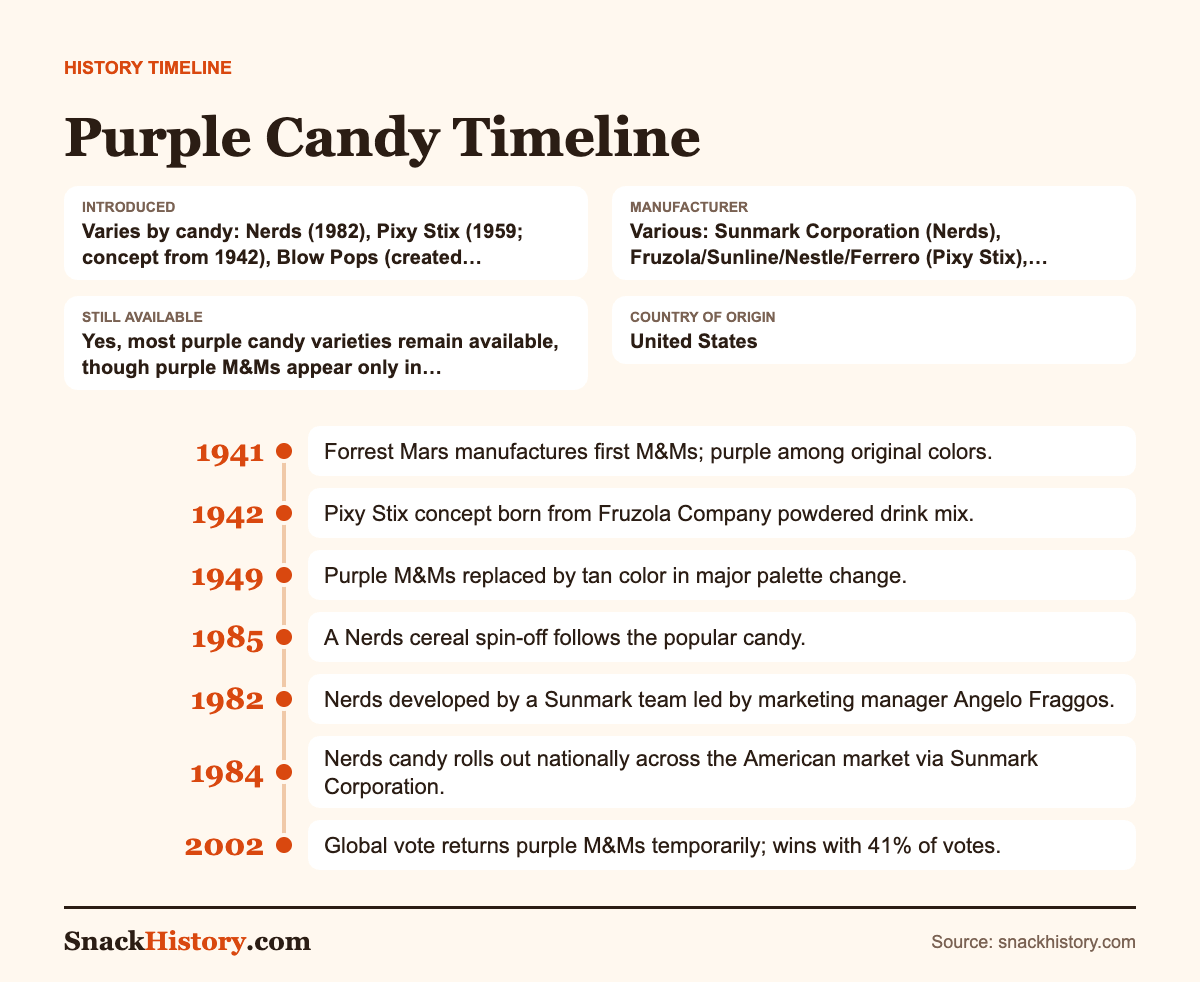
| Purple Candy | Facts |
|---|---|
| Introduced | Varies by candy: Nerds (1982), Pixy Stix (1959; concept from 1942), Blow Pops (created by Thomas Tidwell) |
| Manufacturer | Various: Sunmark Corporation (Nerds), Fruzola/Sunline/Nestle/Ferrero (Pixy Stix), Charms Candy Company (Blow Pops), Mars (M&Ms) |
| Candy Type | Assorted: sugar-coated pieces, powder straws, chocolate-coated candies, lollipops with gum centers |
| Original Flavors | Grape is the dominant purple candy flavor across most brands including Nerds, Pixy Stix, and Blow Pops |
| Still Available | Yes, most purple candy varieties remain available, though purple M&Ms appear only in limited seasonal mixes |
| Country of Origin | United States |
| Parent Company | Various: Ferrero SpA (Pixy Stix/Nerds), Mars Inc. (M&Ms), Charms Candy Company (Blow Pops) |
| Color Significance | Purple is associated with royalty, luxury, and creativity, and universally signals grape flavor across candy brands |
Purple Candy Timeline
- 1941 — Forrest Mars manufactures first M&Ms; purple among original colors.
- 1942 — Pixy Stix concept born from Fruzola Company powdered drink mix.
- 1949 — Purple M&Ms replaced by tan color in major palette change.
- 1985 — A Nerds cereal spin-off follows the popular candy.
- 1982 — Nerds developed by a Sunmark team led by marketing manager Angelo Fraggos.
- 1984 — Nerds candy rolls out nationally across the American market via Sunmark Corporation.
- 2002 — Global vote returns purple M&Ms temporarily; wins with 41% of votes.
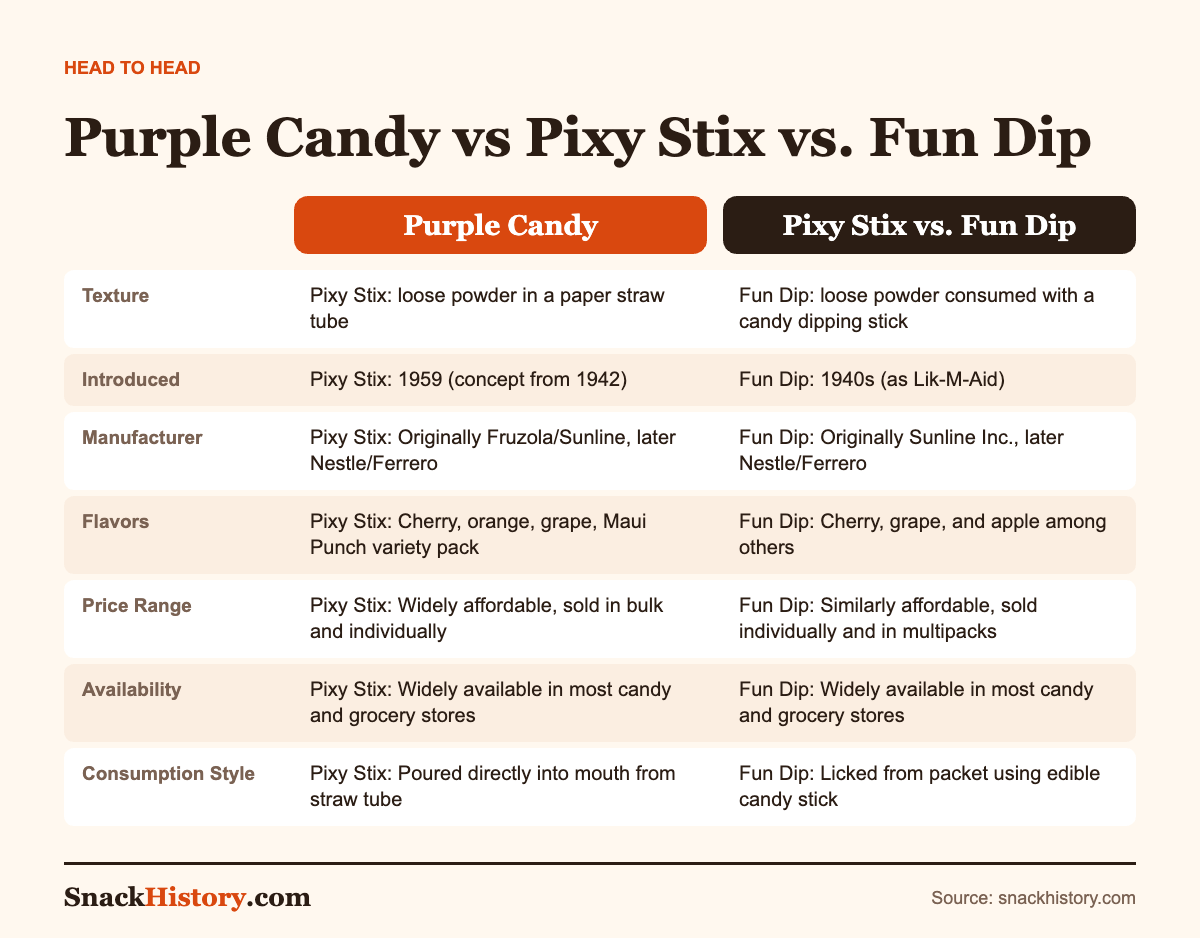
Purple Candy vs Pixy Stix vs. Fun Dip
| Feature | Purple Candy | Pixy Stix vs. Fun Dip |
|---|---|---|
| Texture | Pixy Stix: loose powder in a paper straw tube | Fun Dip: loose powder consumed with a candy dipping stick |
| Introduced | Pixy Stix: 1959 (concept from 1942) | Fun Dip: 1940s (as Lik-M-Aid) |
| Manufacturer | Pixy Stix: Originally Fruzola/Sunline, later Nestle/Ferrero | Fun Dip: Originally Sunline Inc., later Nestle/Ferrero |
| Flavors | Pixy Stix: Cherry, orange, grape, Maui Punch variety pack | Fun Dip: Cherry, grape, and apple among others |
| Price Range | Pixy Stix: Widely affordable, sold in bulk and individually | Fun Dip: Similarly affordable, sold individually and in multipacks |
| Availability | Pixy Stix: Widely available in most candy and grocery stores | Fun Dip: Widely available in most candy and grocery stores |
| Consumption Style | Pixy Stix: Poured directly into mouth from straw tube | Fun Dip: Licked from packet using edible candy stick |
6 Most Popular Purple Candy Available on the Market
1. Nerds Candy

Nerds were developed by a team at Sunmark’s Willy Wonka Candy Company and launched in the early 1980s, giving us the delightfully little, sugar-coated candy pebbles known today as Nerds. A Nerds cereal spin-off followed in the mid-1980s.
Over the years, many flavors have been added. They’re delicious little sweets.
Nerds candies were produced by the Sunmark Corporation and first appeared on the American market in 1982. Because they typically come in pairs, nerds stand out. Although you may obtain them in mixed flavors, most boxes you purchase will only have two varieties. You receive two tastes in one box as a result.
There are small candy boxes, of course, and they usually contain just one flavor, which is indicated by the color of the candy and the packaging. For example, purple candy has a grape flavor.
Since the majority of these varieties come in duos, if you buy a standard size, you’ll receive strawberry and grape or another flavor combination. You’ll discover that the same flavors are typically combined with little modification or variation.
2. Purple Pixy Stix

Pixy Stix is a sweet and sour treat, packaged in a little tube that resembles a paper straw. These little packets each contain a mouthful of sweet, tangy candy with a fruit taste that you can eat by pouring it into your mouth. Fruzola (later Sunline) initially produced these simple sweets in St. Louis. A variety pack of this purple candy has a mix of cherry, orange, Maui Punch, and, of course, grape.
This candy was created as a result of the rise in the popularity of water-flavored products. Many people mistakenly believe that Pixy Stix was created out of thin air. However, this candy was really the outcome of this research with another item.
The original candy was first created in 1942 as a spinoff of a powdered treat offered by the Fruzola Company. Instead of being consumed as a drink when combined with water, this drink mix was consumed by people in powder form. This gave rise to the concept of Pixy Stix and resulted in the production of this iconic treat.
The powder was sold as Lik-M-Aid; the Fruzola Company of St. Louis, later renamed Sunline Inc., marketed it nationwide and in 1959 repackaged it in striped straws as Pixy Stix. Nestle acquired the confectionery and modified its marketing strategies to make the Wonka brand more appealing to children of all ages. However, it recently sold the line of candies to Ferrero SpA.
3. Purple M&Ms

If you’re one of those individuals who try to arrange their M&M’s candies by color upon opening a packet so that they make a pretty rainbow, you’ve undoubtedly noticed that there isn’t a purple candy hue to follow the blue, as there would be in a true rainbow.
When Forrest Mars, the son of the man who invented the Milky Way chocolate bar, first manufactured M&Ms in 1941, purple was still among the original hues. However, M&M’s color scheme underwent a significant alteration in 1949 when TAN took the place of purple. Although this brownish hue is in no way superior to purple, there haven’t been any convincing justifications for this alteration until now. It seems to be a mystery, which seems almost like an illegitimate seizure of the sugar kingdom.
Aqua, pink, and purple were the options for the 2002 candy manufacturer’s global vote to add a new hue to the sweet palette. With 41% of the vote, a racer in royal colors came out on top this time. The purple M&M exalted after being banished for years. But things never go as we anticipate because life frequently takes unforeseen detours. The purple candy was quickly taken from the ordinary package again once it had sold out because the vote was only for a temporary promotion.
Despite not being the center of attention in shops, you may still find the enigmatic prince of M&Ms in some uncommon seasonal combinations. You simply need to keep an eye out for it, and you could get the chance to taste a piece of the history of purple candy that is intricately crafted.
4. Grape Blow Pops

Thomas Tidwell is credited with creating Charms Blow Pops. The Charms Candy Company would subsequently spread awareness of this product. Even though they are no longer the firm that promotes them, this is currently their best-selling product of all time. The grape flavor of Blow Pops is a beautiful purple color.
Charms Candy Company was purchased by Tootsie Roll Industries in 1988. Just in time for the Tootsie Roll candy lineup to make Tootsie Roll the largest lollipop maker in the world, the Blow Pop was added to their Tootsie Roll range. Charms candies had comforted soldiers in the Second World War, and Blow Pops, sold by Charms from 1973, would be enjoyed by kids and adults for years. At this point, Tootsie Roll was not the product’s owner, but they succeeded when they did so later in the product’s life.
Watermelon, strawberry, cherry, grape, and sour apple Charms Blow Pops were the flavors offered for sale.
This purple candy is a highly popular Halloween treat right now, and every year, both the full-size and mini-size candies are distributed to trick-or-treaters. Kids are always quite pleased to get such a distinctive and fun candy at a house they approach for treats on this occasion, making this one of the crucial times of the year for sales of this product.
5. Milka

One of the most well-known chocolate product brands in Europe is Milka. You may have seen the posters depicting a rare purple cow in an Alpine meadow. Since 1901, Milka, a chocolate brand created by the Swiss chocolatier Suchard and made in Lörrach, Germany, has captured the hearts of chocolate lovers everywhere, with its “Lila” cow logo appearing since the early 1970s.
In the late 1800s, Henri Nestlé, the founder of Nestlé, created a powdered milk product. As a result of this commercial success, his friend Daniel Peter invented milk chocolate.
The three primary components of Milka purple candy are cocoa beans, 100% Alpine milk powder, and sugar. However, we should keep in mind that Milka comes in a variety of flavors, and various tastes require different ingredients.
Although Milka conjures up images of amazing tastes, it also evokes positive emotions such as happiness, love, and pleasure. That is precisely how this purple candy wants us to feel and think while we use and appreciate its products. Everyone continues to adore Milka even after all these years.
6. Kool-Aid Popping Candy (Grape Flavor)

Kool-Aid is an American sweet that offers purple candy variations. It is owned by the Chicago, Illinois-based Kraft Heinz corporation. The principal form, powder, was initially developed in 1927 by Edwin Perkins, who got the idea from Fruit Smack, a then-popular liquid concentrate that was the source of his invention.
Over the years, there have been several taste variants available. While certain tastes in the series have remained constant and won’t ever alter or be dropped, other flavors come and go. They’ve also added some new products and drinks, such as the twist-off Kool-Aid bursts, which are already combined into liquid form.
Original Kool-Aid flavors include grape, cherry, orange, strawberry, raspberry, and lemon-lime. There are Kool-Aid collectibles available today that are quite valuable. In some ways, it resembles items like Coca-Cola memorabilia.
The arrangement with Soda Stream to make Kool-Aid tastes accessible to be used in conjunction with the Soda Steam machine that individuals use to brew sodas in their homes was one novel addition to Kool-Aid. The deal between Kraft and Soda Stream took place in 2012.
Bottom Line
To sum it up, the world of purple candy is full of variety and flavor. Therefore, it has become an essential part of events and celebrations around the world. Whether it’s fruity grape and blackberry flavors or soothing lavender and plum flavors, there’s a purple candy for everyone. Today, children and adults alike enjoy the taste and look of the colorful treats that we call purple candy.
So, next time you have a sweet craving, try a luxurious and regal purple candy and see for yourself how delicious they are!
Frequently Asked Questions about Purple Candy
Why is grape the most common flavor for purple candy?
Across many candy brands, purple coloring is used to signal grape flavor to consumers. For example, Nerds candy uses purple packaging and candy color specifically to indicate grape flavor, making the color-flavor association intuitive for shoppers.
Were purple M&Ms ever a permanent product?
Purple was actually one of the original M&M colors when Forrest Mars first manufactured them in 1941, but it was replaced by tan in 1949. In 2002, a global vote brought purple back temporarily as a promotional color, winning with 41% of the vote, but it was removed again once the promotion sold out and has only appeared occasionally in seasonal mixes since.
Who invented Pixy Stix and how did they originate?
Pixy Stix originated in 1942 as a spinoff of a powdered drink mix offered by the Fruzola Company. People began eating the powder dry instead of mixing it with water, which inspired the concept of the candy straw. The Fruzola Company later became Sunline Inc., and the product eventually passed through Nestle and the Wonka brand before being sold to Ferrero SpA.
Who created Nerds candy and when did they launch?
Nerds candy was developed by a team at Sunmark’s Willy Wonka Candy Company led by marketing manager Angelo Fraggos. Nerds were produced by the Sunmark Corporation and introduced on the American market in 1982, rolling out nationally in 1984; a Nerds cereal from Ralston followed in 1985.
What makes Nerds candy unique compared to other purple candies?
Nerds are distinctive because they almost always come in pairs of flavors in a single box, with two separate compartments for two different flavors. Standard-size boxes often include grape and strawberry together, while smaller boxes typically feature just one flavor indicated by the color of the candy and its packaging, with purple signifying grape flavor.
Can you buy purple M&Ms?
Purple M&Ms are not a permanent color. They appear only in limited seasonal mixes. Grape is the dominant flavor of purple candy across brands such as Nerds, Pixy Stix and Blow Pops.
When did Pixy Stix come out?
Pixy Stix came out in 1959, although the powdered candy concept dates back to 1942. Grape is the dominant flavor of purple candy across brands such as Nerds, Pixy Stix and Blow Pops.


Related Posts
Diet Pepsi: History, Flavors & Ingredients
Snack History Nostalgia RatingBig on nostalgia ★★★★★4/5 Quick answer: Diet Pepsi was first tested in 1963 under the name Patio and launched nationally by…
Read more
SunChips: History, Flavors & Ingredients
Snack History Nostalgia RatingBig on nostalgia ★★★★★4/5 Quick answer: SunChips were introduced by Frito-Lay in 1991 as a wavy, whole grain multigrain chip aimed…
Read more
Sno-Caps: History, Origin & Packaging
Snack History Nostalgia RatingPure nostalgia ★★★★★5/5 Quick answer: Sno-Caps came out in 1927, created by the Blumenthal Chocolate Company in Bridesburg, Philadelphia. The semi-sweet…
Read more